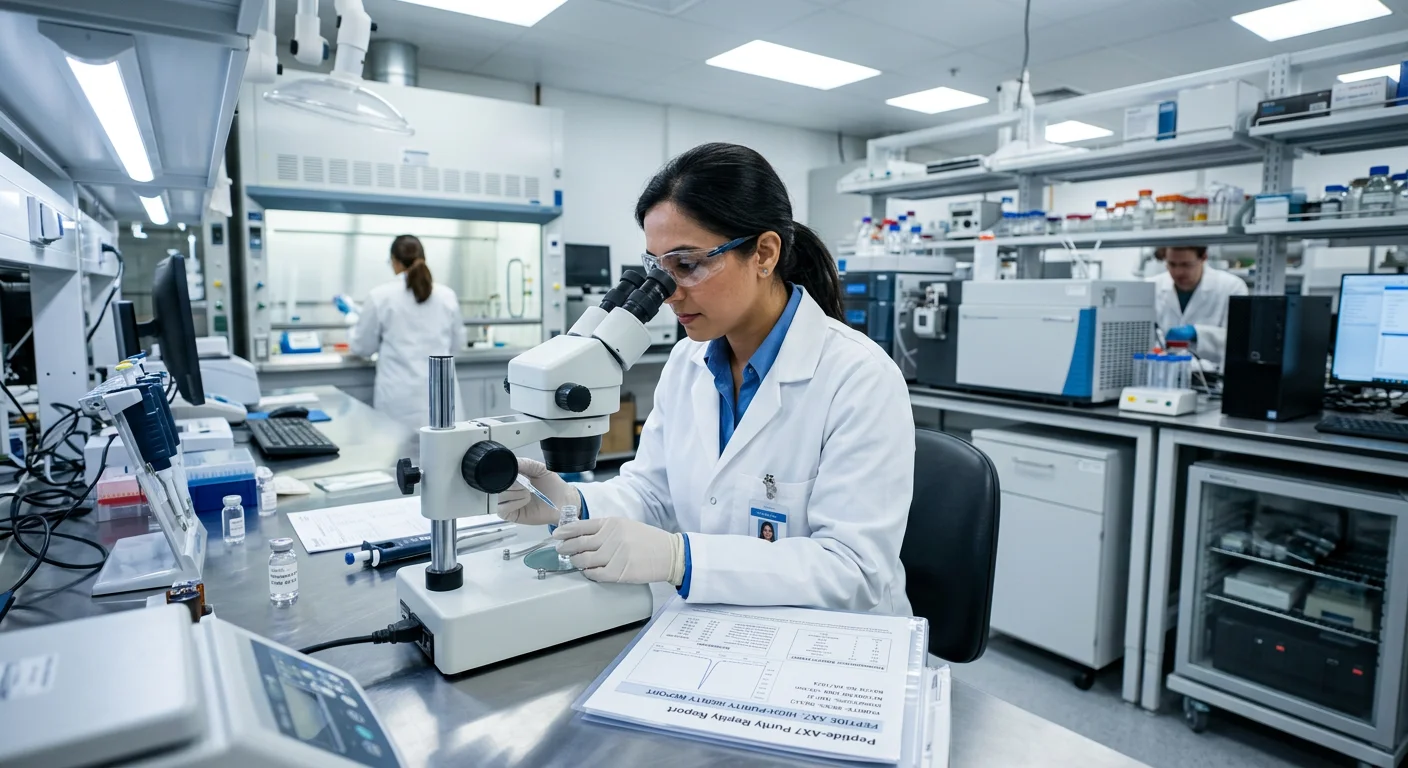
Research use only. All figures referenced here are independent third-party analytical results for laboratory research materials. Nothing here is medical guidance, and these compounds are not for human or veterinary consumption.
A purity percentage on a label is easy to print. A purity percentage you can trace back to a specific tested vial, run by a lab that doesn’t work for the seller, is a different thing entirely. This page is about that difference. It explains what an HPLC purity number actually measures, what it doesn’t, and the reporting standards Bastion holds itself to so that a researcher can check our work instead of taking our word for it.
If you’re looking for the actual numbers per compound, those live on a separate page. We keep the data and the methodology apart on purpose, so the standards don’t get buried under a table. See our Lab Results archive for the per-batch certificates and current verification status.
What an HPLC purity number actually measures
High-performance liquid chromatography is the standard tool for measuring how clean a peptide sample is. The sample gets pushed through a column, and different molecules come out the other end at different times. A detector records each one as a peak. The result is a chromatogram: a line that stays flat, then spikes up wherever something elutes.
Purity is a simple ratio drawn from that picture. The software draws boundaries around each peak, calculates the area under each one, and reports the main peak’s area as a percentage of all the peak area combined. So “99.2% purity” means the target peptide accounts for 99.2% of the total detected peak area, and everything else (truncated sequences, deletion products, leftover synthesis junk, breakdown products) makes up the remaining 0.8%.
That word “area” matters. Purity isn’t a count of molecules and it isn’t a weight measured on a scale. It’s the fraction of the chromatogram that belongs to your compound. A clean result looks like one tall, sharp main peak with very little else around it. A weaker sample shows a cluster of smaller peaks before or after the main one, each shaving a fraction off the headline number.
Reading the chromatogram, not just the number
The number is a summary. The chromatogram is the evidence. A real report shows the trace and usually a table listing each peak’s retention time, its area, and its percentage of the total. When you can see the actual shape, you can ask better questions. Is the main peak symmetric, or does it tail off? Is there one significant impurity peak or a forest of tiny ones? Two samples can both read “98.5%” while telling very different stories about what the other 1.5% is made of.
This is why we link to certificates that include the chromatogram, not screenshots of a single percentage. The full trace is what lets a careful researcher verify the claim rather than accept it.
Purity, quantity, identity, and sterility are four different questions
People collapse all of these into “is it good,” but they answer separate things, and a certificate can ace one while saying nothing about the others.
- Purity tells you what fraction of the detected material is the target compound. It’s the HPLC main-peak number described above.
- Quantity (net peptide content) tells you how many milligrams of actual peptide are in the vial. A vial labeled “10 mg” at high purity still might not contain 10 mg of usable peptide, because lyophilized powder includes counter-ions, residual water, and salts. Purity and net content are different measurements, and both feed into how a researcher plans a study.
- Identity tells you whether the main peak is the molecule you think it is. HPLC can tell you a sample is 99% one thing without telling you what that thing is. Mass spectrometry answers identity by measuring the molecular weight: the observed mass should match the theoretical mass calculated from the sequence, within a small error margin. Purity plus identity together is far stronger than purity alone.
- Sterility and endotoxin are about contamination, not composition. Endotoxin is usually assessed with an LAL assay and reported in endotoxin units per milligram. A peptide can be chemically pure and still carry bacterial endotoxin, so these are separate checks with their own limits.
A purity number says nothing about quantity, identity, or sterility on its own. Honest reporting keeps these distinct instead of letting a single impressive percentage stand in for all four.
Why mass spec belongs next to the HPLC trace
HPLC purity and mass spec identity are often treated as interchangeable, and they aren’t. HPLC sorts a sample by how molecules move through a column and tells you how much of the detected material is your dominant peak. It’s blind to what that peak actually is. You could have a beautifully clean 99% trace of the wrong molecule, and HPLC alone would never flag it.
Mass spectrometry closes that gap. It measures the molecular weight of what came off the column, and that weight is essentially a fingerprint of the sequence. For a given peptide you can calculate the theoretical mass from its amino acid chain, and a credible report shows an observed mass sitting within a small tolerance of that calculated value. When the observed and expected masses line up, you have evidence the dominant peak is the intended compound, not a close-but-wrong analog. Purity from HPLC and identity from mass spec answer two different questions, and seeing both on one certificate is stronger than either alone. A report that gives you a high purity number with no identity data is telling you how clean something is without confirming what it is.
Independent third-party testing vs in-house claims
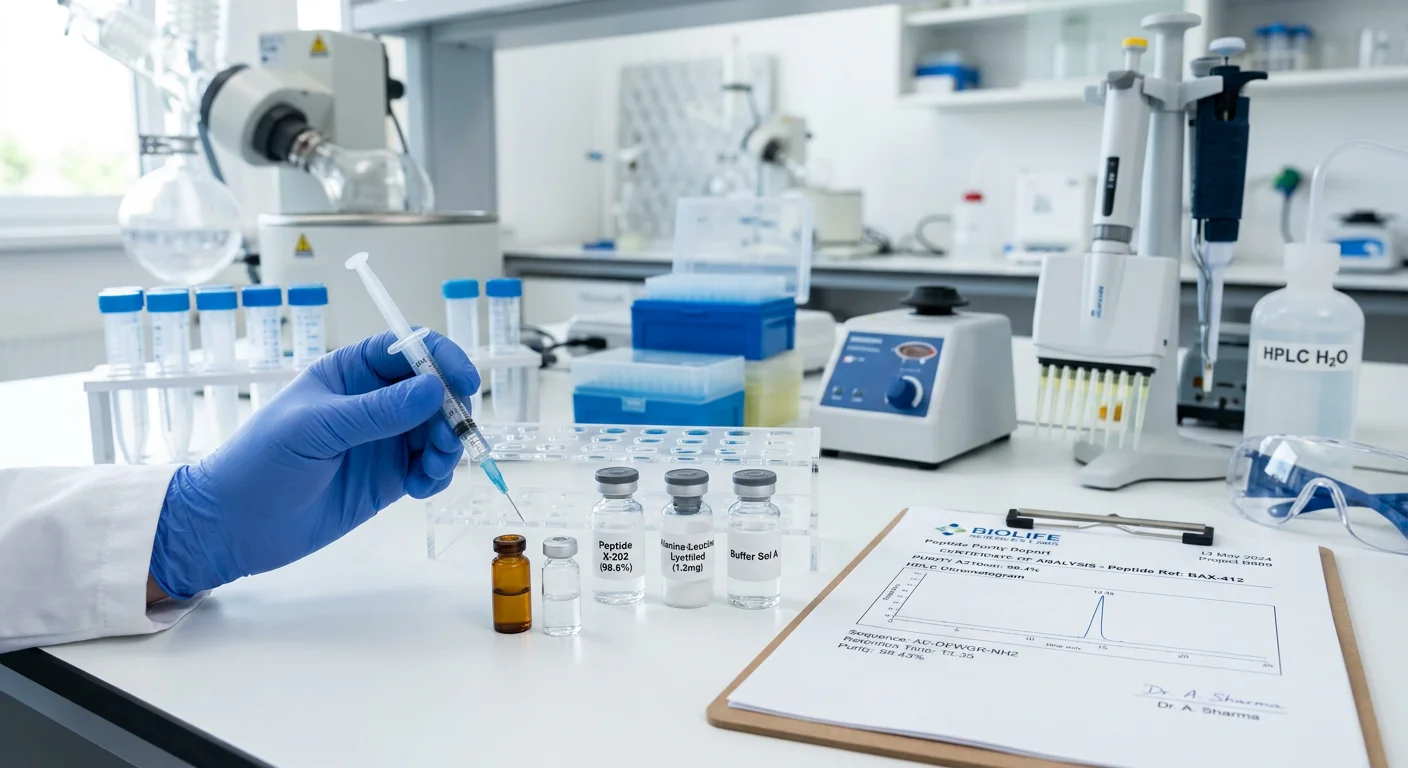
Here’s the uncomfortable part of this market: it’s largely unregulated, and the lab generating the certificate is often the same company selling the product. That’s a conflict of interest. When the seller controls the test, the result is marketing, not data.
Independent third-party testing removes that conflict. The lab has no stake in the answer, so the number it produces is empirical rather than aspirational. This isn’t a small detail. Independent verification studies have repeatedly found supplier certificates that overstate purity, where a claimed 99% turns out lower once a neutral lab runs the same sample. The whole point of using an outside lab is that you, the researcher, are no longer relying on the seller’s honesty.
Bastion sends material to Janoshik Analytical, an independent lab, and the results are hosted on Janoshik’s own servers under a verification code. We don’t host the PDF and ask you to trust it. The certificate lives where we can’t edit it.
Match-batch certificates: the cert has to tie to your lot
A certificate is only meaningful if it describes the vial in front of you. The common trick is reusing one good early certificate for every future batch, so the document on the website was generated from material that has nothing to do with what ships months later. The paper is real. The connection to your product is fiction.
A match-batch standard fixes this. The certificate is tied to the specific lot that gets shipped, so the result you read corresponds to the material you receive, not a flattering sample from a different production run. We explain how this works on our Janoshik match-batch page. When you can match the lot number on your vial to the lot on the certificate, and confirm that certificate on the lab’s independent server, the chain is complete from your hand back to the instrument.
Why we show the whole catalog and the lowest result
It’s tempting to publish only the best number. Find the one batch that hit 99.7%, put it on the homepage, and stay quiet about the rest. That’s a curated highlight reel, and it tells a researcher nothing about typical quality.
We take the opposite approach. We show the full catalog of tested compounds, including the lowest result, because the floor is more honest than the ceiling. A vendor’s worst published number tells you more than their best one. If the lowest result is still high, that’s a real signal about consistency. If a vendor only ever shows one perfect figure, ask what they’re not showing. Our complete set of results, including the lower figures, is on the Lab Results page rather than cherry-picked here.
What “tested” should mean before you trust a result
The word “tested” does a lot of quiet work in this market. It can mean a sample went to a named outside lab, came back with a full chromatogram and a mass spec result, and got posted with a code you can confirm yourself. It can also mean someone glanced at a vial and decided it looked fine. Both get called “tested,” and the gap between them is the whole story.
Our standard is the first version, all the way through. The compound goes to an independent lab. The lab runs HPLC for purity and reports the full trace. The result is posted under a verification code on the lab’s own server, so the document you read is the document the instrument produced, not a version that passed through our hands first. We’d rather give you something you can disprove than something you have to believe. A claim you can check is worth more than a claim you’re asked to accept, even when both land on the same number.
Good vs weak purity reporting
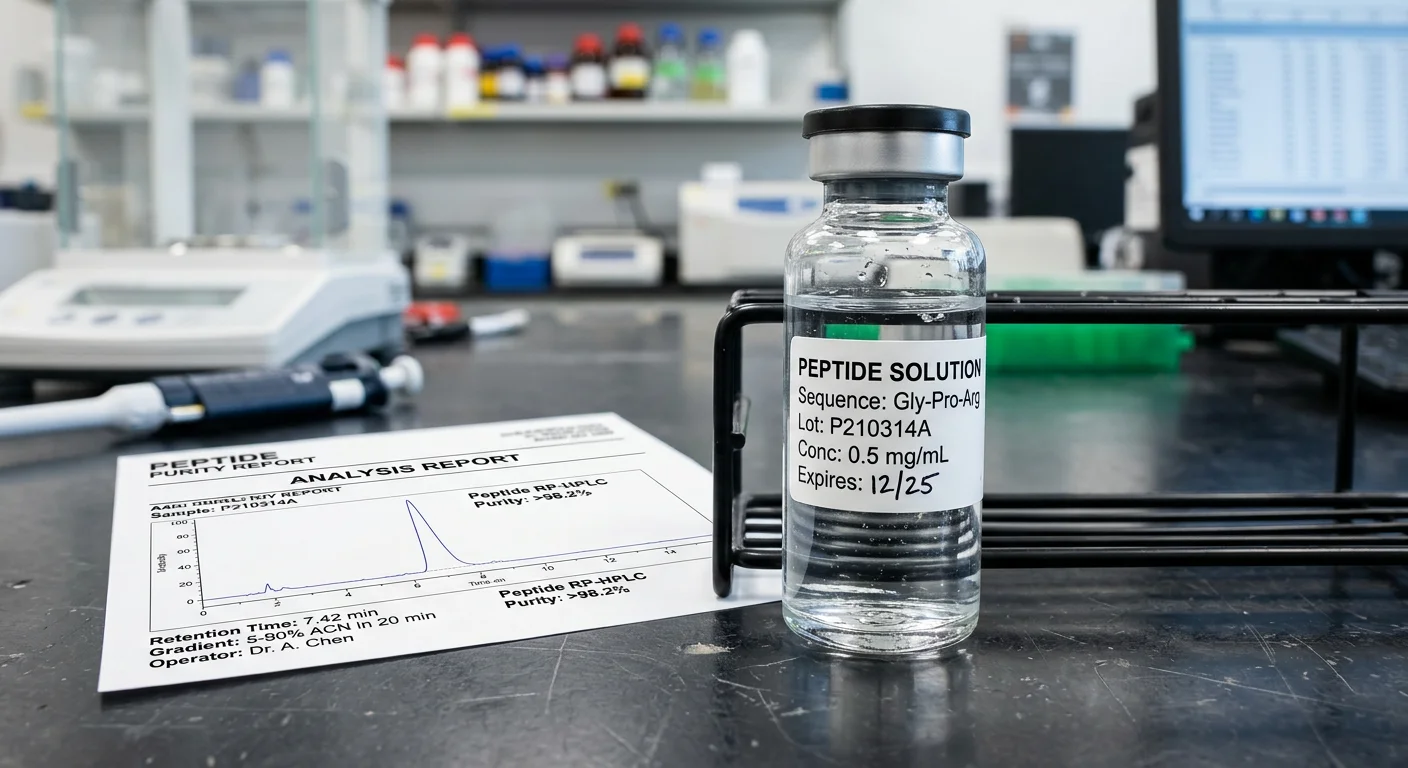
The same word, “tested,” covers a wide range of practices. Here’s how to tell strong reporting from the kind that just looks reassuring.
What good reporting looks like
- The certificate comes from an independent lab, not the seller’s own bench.
- It’s verifiable on the lab’s server through a code the seller can’t alter.
- The full chromatogram is shown, not just a number, so you can see the peaks.
- The certificate ties to a specific lot that matches the shipped vial.
- Identity is confirmed by mass spec alongside the HPLC purity figure.
- The vendor publishes its whole range, including weaker results, with dates.
What weak reporting looks like
- An in-house “QC passed” stamp with no outside lab named.
- A single PDF hosted only on the seller’s site, with no independent way to confirm it.
- A bare percentage and no chromatogram, so you can’t see what the impurities are.
- One certificate reused across many batches and dates.
- Purity quoted alone, with identity and net content left out.
- Only the best result on display and everything else hidden.
If a report fails several of these, the headline number isn’t worth much, however high it reads.
A researcher’s verification checklist
You don’t need to trust any of this. You can check it. Here’s how to read and verify a certificate of analysis before you rely on the material.
- Find the issuing lab. Is it a named, independent third party, or the vendor’s own facility? An outside lab has no reason to inflate the result.
- Verify it at the source. Enter the verification code on the lab’s own site and confirm the certificate matches what the vendor published. If there’s no independent way to confirm it, treat the PDF as a claim.
- Match the lot. Compare the lot or batch number on your vial against the certificate. A mismatch means the result describes different material.
- Open the chromatogram. Look for one clean, dominant peak. Scan for impurity peaks and check the peak table for retention times and areas.
- Confirm identity. Check for a mass spec result and see that the observed mass lines up with the expected mass for that sequence.
- Read the date. A recent certificate that’s specific to the current lot beats an impressive but ancient one.
- Separate the four questions. Note what the report actually covers: purity, quantity, identity, sterility. Don’t let a strong purity figure stand in for the rest.
For a fuller walkthrough with annotated examples, see our guide on how to verify a peptide COA.
The limits of a purity number
Even a verified, lot-matched, third-party HPLC result has edges worth respecting. The number reflects what the method can detect under the conditions used. Some impurities co-elute with the main peak and hide inside it. The detector responds to different molecules differently, so peak area is a close proxy for proportion, not a perfect one. A purity figure is also a snapshot of one sample at one moment, and storage, handling, and reconstitution all happen after the test.
None of that makes the number meaningless. It makes it honest to state what the number is: strong evidence about composition at the time of testing, paired with separate evidence for identity and content, all of it traceable to an independent lab. That’s the standard we report against, and it’s the standard we’d want if we were the ones checking. The certificates are public, the lab is independent, and the verification is in your hands.
Browse the available compounds and their certificates from the Lab Results archive.