CJC-1295 is one of the most frequently studied growth-hormone-releasing hormone (GHRH) analogs in the research peptide literature, and it appears in two distinct forms: with DAC and without DAC (the latter also known as Modified GRF 1-29). The two are chemically related but pharmacokinetically very different. Conflating them is one of the most common errors we encounter in research procurement. This guide explains what each form is, what the underlying mechanism research says, how the two compare on half-life and handling, and what to verify before a compound enters a protocol. All material below is provided strictly for in-vitro and laboratory research context, not for human or veterinary use.
What is CJC-1295?
CJC-1295 is a synthetic analog of the first 29 amino acids of endogenous GHRH (GRF 1-29), the fragment responsible for the molecule’s biological activity at the GHRH receptor. The parent fragment GRF 1-29 is rapidly degraded in plasma, primarily by the enzyme dipeptidyl peptidase-4 (DPP-4). CJC-1295 was engineered with four amino-acid substitutions designed to resist this enzymatic cleavage, extending the window over which the molecule remains intact in the research models where it has been characterized.
Because it acts at the GHRH receptor, CJC-1295 is studied as a secretagogue, a compound that stimulates the body’s own signaling pathways rather than supplying an exogenous hormone directly. In the literature it is frequently examined alongside growth-hormone-releasing peptides (GHRPs) such as ipamorelin, which act on a separate (ghrelin/GHS) receptor.
What “DAC” actually means
DAC stands for Drug Affinity Complex. It refers to an additional chemical group, a maleimidopropionic acid (MPA) linker, attached to the peptide. Once in solution, this linker is designed to bind covalently to circulating serum albumin. Because albumin has a long circulatory half-life, tethering the peptide to it dramatically extends the time the molecule persists before clearance in the research models studied.
This single structural feature is the entire difference between the two products:
- CJC-1295 with DAC, carries the MPA/albumin-binding linker. Designed for sustained presence and a long elimination profile.
- CJC-1295 no DAC (Modified GRF 1-29), the same DPP-4-resistant tetrasubstituted backbone without the albumin linker. Retains a short, pulse-like profile.
CJC-1295 no DAC = Modified GRF 1-29
The “no DAC” form is chemically identical to what is often labeled Modified GRF 1-29 (sometimes written Mod GRF 1-29 or CJC-1295 DAC-free). The naming inconsistency across suppliers is a frequent source of confusion in procurement. When a listing reads “CJC-1295 no DAC 2mg” and another reads “Modified GRF 1-29,” they are referring to the same molecule. Verifying the sequence and purity on a third-party certificate of analysis is the only reliable way to confirm what is actually in a vial, regardless of the name on the label.
Half-life and pharmacokinetics: a side-by-side
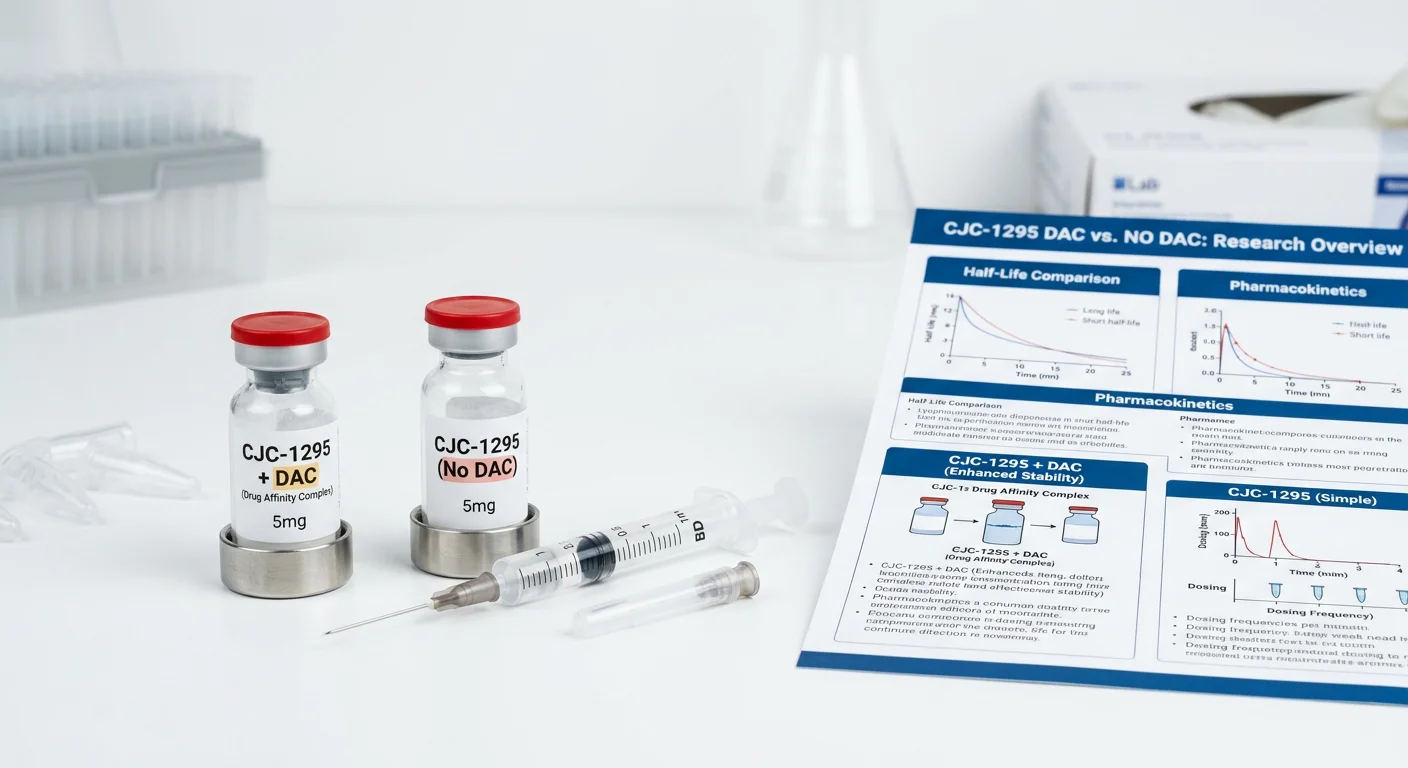
The defining contrast between the two forms is duration of action in the research models where they have been characterized. Across the Match-Batch COAs we’ve reviewed, the pharmacokinetic differences are striking and consistent. The table below summarizes the commonly cited distinctions.
| Property | CJC-1295 no DAC (Mod GRF 1-29) | CJC-1295 with DAC |
|---|---|---|
| Albumin-binding linker | No | Yes (MPA) |
| Reported half-life (research models) | ~30 minutes | Several days |
| GH-release profile studied | Sharp, pulsatile | Sustained, prolonged “bleed” |
| Backbone | Tetrasubstituted GRF 1-29 | Tetrasubstituted GRF 1-29 |
| Common research pairing | GHRP (e.g., ipamorelin) | GHRP or standalone |
The short half-life of the no-DAC form is precisely why it is studied in models examining pulsatile GH signaling, the natural rhythm in which growth hormone is released. The DAC form, by contrast, is used in models where a prolonged elevation is the variable of interest. Neither is “better”; they answer different research questions.
Why the two are studied differently
Endogenous growth hormone is secreted in pulses, and a substantial body of preclinical work suggests the pattern of exposure, not just the total amount, influences downstream signaling. Researchers investigating pulsatile dynamics typically favor the short-acting no-DAC form, often co-administered with a GHRP in study designs that probe receptor synergy. Researchers whose model requires a steady, days-long elevation tend to select the DAC form. This is the single most important consideration when choosing between the two compounds for a given protocol.
The four substitutions, and why identity testing matters
The “tetrasubstituted” backbone shared by both forms refers to four specific amino-acid replacements engineered into the native GRF 1-29 sequence. These substitutions are what confer resistance to DPP-4 cleavage and improve stability relative to the unmodified fragment. Because the difference between native GRF 1-29, Modified GRF 1-29 (no DAC), and the DAC-linked form comes down to a small number of residues plus an optional linker, visual inspection of a powder tells a researcher nothing. Two vials that look identical can be entirely different molecules. When we audit a new batch, we check the LC-MS trace first, identity confirmation answers “is this the molecule claimed?”; purity testing answers “how much of the sample is that molecule versus impurities?” A rigorous COA reports both.
Common procurement mistakes
Several recurring errors show up when research groups source CJC-1295:
- Treating “CJC-1295” and “CJC-1295 DAC” as interchangeable. A listing that simply says “CJC-1295” is ambiguous; always confirm whether the DAC linker is present, because it changes the half-life from minutes to days.
- Accepting a single representative COA. A certificate from a different batch than the one shipped does not characterize the material in hand. Per-lot (Match-Batch) testing is the standard that supports reproducible work.
- Relying on a vendor-hosted PDF only. A COA that cannot be independently verified on the testing lab’s own database can be edited after issuance. The verification URL should resolve to a record outside the vendor’s control.
- Ignoring storage state on arrival. Material should arrive lyophilized. A compound that has degraded in transit will not give clean data regardless of how it tested at the lab.
Reconstitution and research handling
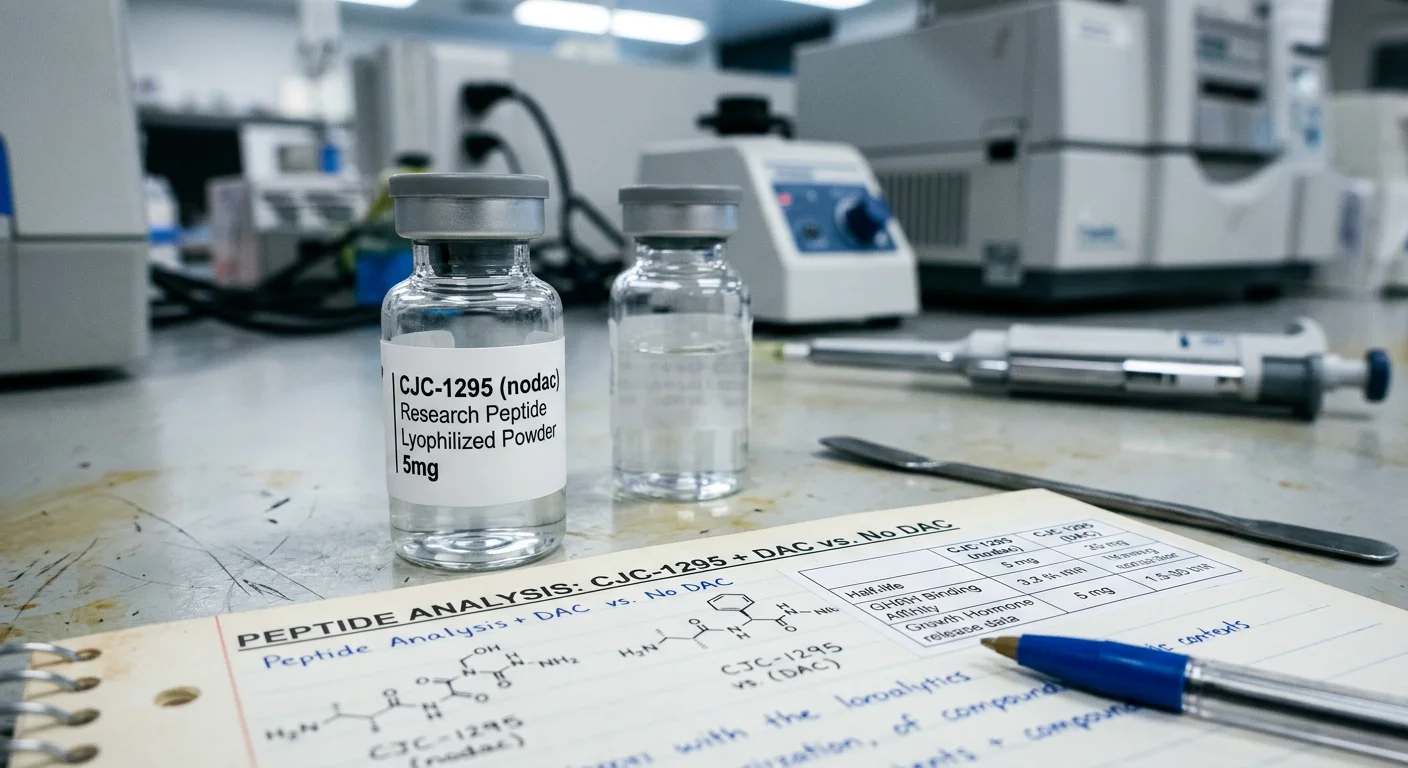
Both forms ship as lyophilized (freeze-dried) powder and require reconstitution with bacteriostatic water before use in solution-phase research. Concentration math matters: the same 2 mg vial yields very different working concentrations depending on the diluent volume. Our peptide reconstitution calculator guide walks through the mg-per-vial to concentration conversion with worked examples. Reconstituted peptide is generally handled cold and protected from repeated freeze-thaw cycles; lyophilized material is the more stable shipping and storage state, which is why cold-chain logistics matter for these compounds.
Verifying purity before a compound enters a protocol
Reproducibility in peptide research depends on knowing the identity and purity of the exact lot in hand. Independent third-party testing, HPLC for purity and mass spectrometry for identity, is the standard. In our experience, researchers who skip identity verification often discover mid-protocol that they’ve been working with the wrong compound entirely. Every Bastion lot is submitted to Match-Batch verification, tying one independent Janoshik certificate to one production batch rather than reusing a representative document. Before relying on any supplier’s CJC-1295 (either form), confirm the COA resolves to a real record on the testing lab’s own database, shows ≥99% HPLC purity, and matches the specific batch you received.
Frequently asked questions
Is CJC-1295 no DAC the same as Modified GRF 1-29?
Yes. CJC-1295 without DAC and Modified GRF 1-29 refer to the same tetrasubstituted GRF 1-29 molecule. The difference in naming is a labeling convention, not a chemical difference. Confirm via the sequence and COA rather than the product name.
What is the difference between CJC-1295 with DAC and without DAC?
The DAC (Drug Affinity Complex) version carries an albumin-binding linker that extends its half-life to several days; the no-DAC version lacks that linker and has a half-life of roughly 30 minutes, producing a short pulsatile profile in research models.
Why is CJC-1295 often researched alongside ipamorelin?
CJC-1295 acts at the GHRH receptor while ipamorelin acts at the separate ghrelin/GHS receptor. Study designs frequently pair a GHRH analog with a GHRP to examine receptor synergy on growth-hormone signaling.
How should CJC-1295 be stored for research use?
Lyophilized powder is the most stable state and is typically kept cold and dry. Once reconstituted, the literature describes refrigerated handling and avoidance of repeated freeze-thaw cycles to preserve peptide integrity.
What purity should a CJC-1295 COA show?
Research-grade material is generally expected to test at ≥99% HPLC purity with mass-spectrometry identity confirmation. The COA should be from an independent third-party lab and resolve to a verifiable record on that lab’s own database.
Does the 2mg vial size differ between the DAC and no-DAC forms?
Both Bastion CJC-1295 products are supplied as 2mg lyophilized vials. The peptide mass is the same; the pharmacokinetic difference comes entirely from the presence or absence of the DAC linker, not the vial size.
Is CJC-1295 approved for human use?
No. CJC-1295 in both forms is supplied strictly as a research compound for in-vitro and laboratory study. It is not a medicine and is not intended for human or veterinary administration, diagnosis, or treatment.
Choosing the right form for your research
The decision reduces to the variable your model is testing. If the question concerns pulsatile GH dynamics or short-window receptor activity, frequently in combination with a GHRP, the CJC-1295 no DAC 2mg form is the literature-standard choice. If the model requires sustained, multi-day elevation, the CJC-1295 with DAC 2mg form is designed for that profile. In both cases, batch-level COA verification is the prerequisite for reproducible data. Bastion supplies both forms as lyophilized 2mg vials with free customs reship to the USA and Canada; both are currently pending their first independent Janoshik Match-Batch test — check the lab results page for current status.
Research use only. The information above summarizes published mechanism and pharmacokinetic research and is not medical advice. These compounds are not for human or veterinary consumption.

Related research guides
- GLP-1 research peptides: Semaglutide vs Tirzepatide vs Retatrutide
- Growth hormone secretagogues: GHRH analogs vs GHRPs
- Longevity research peptides: Epithalon, NAD+, MOTS-c & Pinealon
- DSIP (Delta Sleep-Inducing Peptide) research guide
- BPC-157 + TB-500 recovery stack
Related research guides
- Growth Hormone Secretagogues: GHRH Analogs vs GHRPs (Research Guide)
- Longevity Research Peptides: Epithalon, NAD+, MOTS-c & Pinealon
- DSIP (Delta Sleep-Inducing Peptide): A Research Guide
See our affiliate program.
Research Use Only. Not for human consumption.
Sourcing & verification: Verified Bastion lots ship with an independent Janoshik match-batch COA you can verify yourself; compounds still pending testing are listed as such on the lab results page. Current availability: CJC-1295 No DAC 2mg (research use only, verification pending).