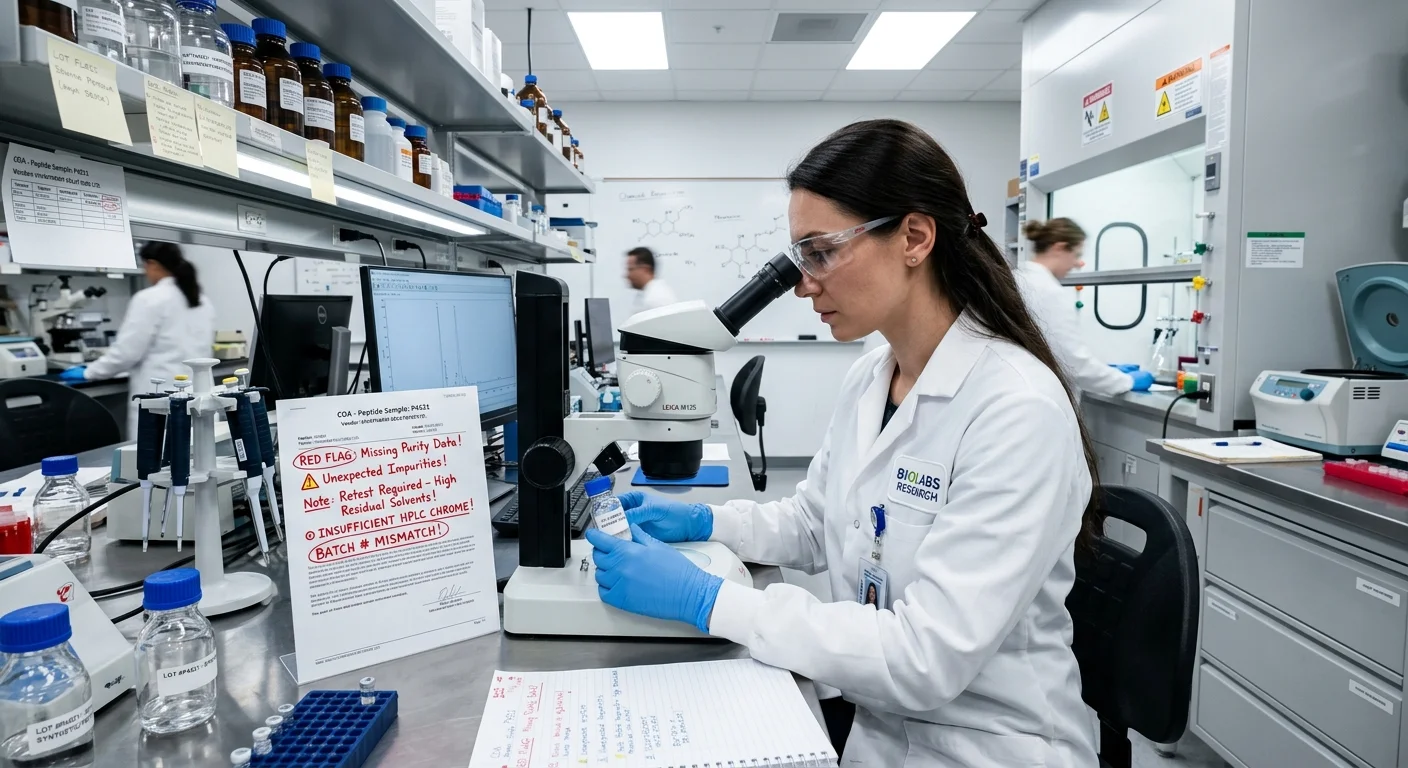
The research peptide market has a verification problem. After major vendors shut down in 2024, buyers migrated to suppliers with inconsistent quality control practices. The most dangerous pattern: single-COA peptide vendors who post one Certificate of Analysis and reuse it across multiple production batches for 6-12 months. This practice creates a verification gap where buyers assume they’re getting tested product when they’re actually receiving untested inventory from different manufacturing runs. Understanding how to identify these vendors, and what legitimate batch-matched testing looks like, is critical for research integrity.
This article explains the single-COA problem, shows you how to verify COAs independently on janoshik.com, identifies red flags in vendor COA practices, and demonstrates why match-batch verification (one Janoshik test per production batch) represents the only defensible quality standard for research-grade peptides.
What Single-COA Peptide Vendors Actually Do
A single-COA peptide vendor operates by posting one Certificate of Analysis, typically from a third-party lab like Janoshik, and applying that test result to all units of a compound they sell, regardless of when those units were manufactured. The practice works like this:
The vendor orders 100 vials of Semaglutide from a Chinese manufacturer in January. They send one vial to Janoshik for HPLC testing. Janoshik returns a COA showing 98.7% purity. The vendor posts this COA on their product page. In March, they order another 100 vials from the same manufacturer (or a different one). They do not test this batch. They continue displaying the January COA. In June, they reorder again. Same COA. By December, customers are buying from the fourth or fifth production batch while viewing test results from a sample that’s 11 months old and came from completely different raw material.
This creates three problems: batch variance (peptide purity fluctuates 3-8% between production runs even from the same manufacturer), manufacturing substitution (vendors switch suppliers without retesting), and degradation masking (older batches may have degraded during storage, but the COA shows fresh product). The single-COA model is economically attractive. One $300 Janoshik test can be amortized across thousands of vials. But it provides zero assurance about what’s actually in the vial a customer receives.
Match-batch verification solves this by requiring one Janoshik test per production batch. When Bastion Peptides receives a new batch of a verified compound, that batch gets its own Janoshik test before sale; compounds still pending their first test are marked as such on the lab results page. The batch number on the vial matches the batch number on the COA, which can be independently verified on janoshik.com. This is the standard pharmaceutical companies use for GMP manufacturing. Research peptide vendors should use it too.
How to Verify COAs on Janoshik.com (Not Vendor Domains)
Legitimate Janoshik COAs include a verification code that allows independent confirmation on janoshik.com. This is the only verification method that matters. Never trust a COA PDF hosted on a vendor’s domain without checking it on Janoshik’s site. Here’s the verification process:
Step 1: Locate the Janoshik ID or verification code on the COA. It appears as a string like “240315.1” or similar format in the header or footer. Step 2: Go to janoshik.com and navigate to the verification page (typically janoshik.com/tests/). Step 3: Enter the ID code. Janoshik’s database will return the original test result, date, and sample description. Step 4: Compare the returned data to the vendor’s posted COA. The purity percentage, test date, and compound name must match exactly. Step 5: Check the test date against the vendor’s claimed batch date. If the COA is dated six months before the batch was supposedly manufactured, it’s not a match-batch COA.
Red flag: Vendors who post COA PDFs but don’t include verifiable Janoshik IDs. Red flag: Vendors whose “lab results” page shows COAs with dates 8-12 months old but claims “current batch testing.” Red flag: COAs that can’t be verified on janoshik.com because the ID doesn’t exist or returns different data. Across the match-batch COAs we’ve reviewed, legitimate vendors consistently provide Janoshik IDs that verify within 24-48 hours of posting. Bastion Peptides publishes all Janoshik IDs on the lab results page with batch numbers, allowing customers to verify every claim independently.
The Batch Number Trick: Why It Matters
Batch numbers are the linchpin of verification. A batch number identifies a specific production run from a specific manufacturer on a specific date. Pharmaceutical manufacturers stamp batch numbers on vials, link those numbers to COAs, and maintain traceability from raw material to end user. Research peptide vendors should do the same. Most don’t.
Here’s what legitimate batch tracking looks like: The manufacturer assigns a batch number (e.g., “BP-SEM-240815”). The vendor receives vials stamped with that batch number. The vendor sends a vial from that batch to Janoshik. Janoshik tests it and issues a COA referencing the batch number. The vendor posts the COA with the batch number visible. Customers receive vials stamped with the same batch number and can match it to the posted COA. If the batch number on your vial doesn’t match the batch number on the COA, you’re not getting tested product.
Single-COA peptide vendors avoid batch numbers because batch numbers expose the reuse problem. If every vial has the same batch number for six months, customers will notice. If vials have different batch numbers but only one COA exists, customers will ask questions. The solution: omit batch numbers entirely or use vague labels like “Batch A” that can be reused indefinitely. When we audit a new batch, we check the LC-MS trace first, then cross-reference the batch identifier against our internal tracking system. When evaluating a vendor, ask: “What batch number is on the vial I’ll receive, and can I see the Janoshik COA for that specific batch?” If the vendor can’t answer, walk away.
| Verification Element | Match-Batch Standard | Single-COA Practice |
|---|---|---|
| Batch Number on Vial | Unique per production run | Omitted or reused across months |
| COA Date vs. Purchase Date | Within 30-60 days | Often 6-12 months old |
| Janoshik ID Verification | Verifiable on janoshik.com | Often missing or unverifiable |
| Number of COAs per Compound | One per batch received | One reused indefinitely |
Red Flags: How to Identify Single-COA Peptide Vendors
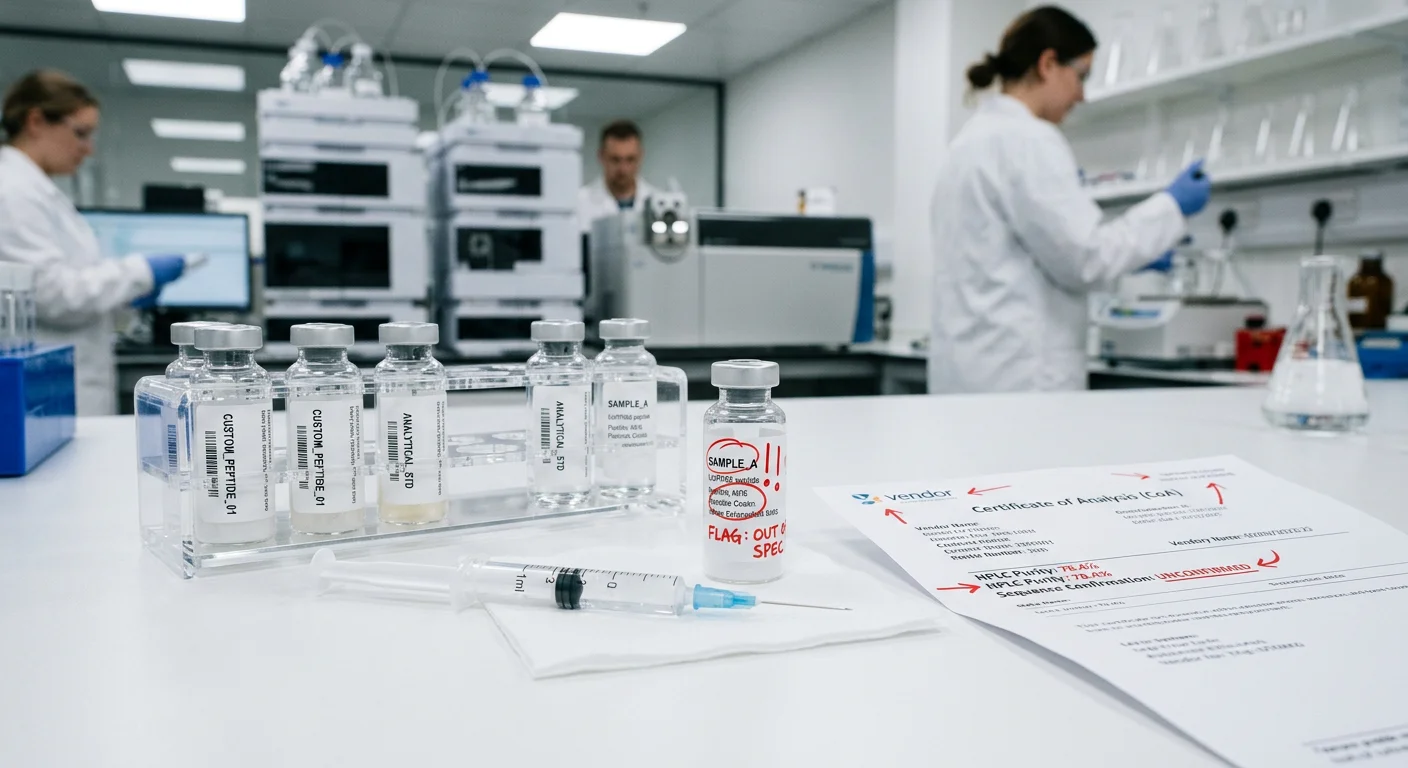
Spotting single-COA vendors requires looking at their COA posting behavior over time. Here are the definitive red flags:
Red Flag 1: Old COA Dates. Check the test date on posted COAs. If a vendor’s Semaglutide COA is dated January 2024 and it’s now October 2024, that’s a single-COA vendor. Legitimate vendors post new COAs every 4-8 weeks as new batches arrive. For verified compounds, Bastion Peptides typically posts 2-4 new COAs per compound per quarter because we receive multiple batches and test each one; compounds pending their first test are listed separately on the lab results page.
Red Flag 2: No Batch Numbers on Product Pages. If the product page shows a COA but doesn’t specify which batch that COA corresponds to, the vendor is hiding batch variance. Match-batch vendors display batch numbers prominently because it’s the proof of verification.
Red Flag 3: COAs Hosted Only on Vendor Domain. Some vendors post “lab results” as PDFs on their own servers without Janoshik IDs. This allows them to fabricate or alter results. Always demand Janoshik-verifiable COAs. If the vendor says “our lab results are proprietary,” they’re lying.
Red Flag 4: Identical Purity Across Batches. Peptide purity varies between batches. If a vendor’s COAs for the same compound always show 98.5% purity across six months, they’re posting the same test repeatedly. Real batch testing shows variance: 97.8%, 98.9%, 96.4%, 99.1%. That’s normal manufacturing variation.
Red Flag 5: No Match Between Vial Label and COA. Order a vial. Check the batch number on the label. Compare it to the COA. If they don’t match, return the product and find a different vendor. This is the simplest verification test and the one most buyers skip.
When evaluating vendors, use the Bastion Peptides lab results page as a reference standard. Every COA includes a Janoshik ID, batch number, test date, and compound name. You can verify every entry on janoshik.com. This is what match-batch verification looks like in practice.
Why Vendors Use Single-COA (Economics and Incentives)
Testing is expensive. A full Janoshik HPLC test costs $250-$350. If a vendor sells 20 peptide compounds and receives new batches quarterly, that’s $20,000-$28,000 in annual testing costs. Single-COA vendors eliminate this expense by testing once per compound and reusing the result. The economic incentive is clear: higher margins.
The second incentive is failure concealment. If a vendor receives a batch that tests at 92% purity (below the 95% threshold most buyers expect), they can choose not to post that COA and continue displaying the old 98% result. Match-batch vendors can’t hide failures because each batch gets its own test. If a batch fails, it doesn’t get sold. Single-COA vendors can sell failed batches while showing passing COAs from previous batches.
The third incentive is supplier flexibility. Match-batch vendors are locked into manufacturers who produce consistent quality because every batch gets tested. Single-COA vendors can switch to cheaper manufacturers mid-year without customers noticing, as long as the old COA stays posted. This creates a race to the bottom: vendors compete on price by sourcing cheaper peptides and hiding the quality decline behind outdated COAs.
From a buyer’s perspective, the single-COA model is a negative-sum game. You pay for tested product but receive untested inventory. The vendor saves money. You absorb the risk of batch variance, manufacturing substitution, and degradation. The only way to break this dynamic is to demand match-batch verification and refuse to buy from vendors who won’t provide it.
Match-Batch Verification: The Only Defensible Standard
Match-batch verification means one Janoshik test per production batch, with the batch number on the vial matching the batch number on the COA. This is the standard Bastion Peptides operates on. Here’s why it’s the only defensible approach for research-grade peptides:
Traceability. Match-batch COAs create an auditable chain from manufacturer to end user. If a research protocol produces unexpected results, the researcher can trace back to the exact batch, verify the purity, and rule out (or confirm) peptide quality as a variable. Single-COA vendors eliminate this traceability.
Batch Variance Visibility. Peptide synthesis is not perfectly reproducible. Purity varies 3-8% between batches even from high-quality manufacturers. Match-batch testing makes this variance visible. Researchers can select batches with higher purity for critical experiments. Single-COA vendors hide variance, forcing researchers to gamble on unknown quality.
Manufacturer Accountability. When vendors test every batch, manufacturers know their output will be scrutinized. This creates upstream pressure for quality control. Single-COA vendors remove this pressure, allowing manufacturers to cut corners on batches that won’t be tested.
Storage Degradation Detection. Peptides degrade over time, especially if stored improperly. A batch that tested at 98% purity six months ago may now be at 94%. Match-batch vendors test fresh inventory. Single-COA vendors can sell degraded product while displaying fresh test results.
The cost of match-batch verification is real but manageable. Bastion Peptides absorbs testing costs as a cost of quality rather than passing them to customers via higher prices. The alternative—selling untested product—is unacceptable for a research-grade vendor. If you’re serious about research integrity, you verify every batch. If you’re optimizing for margins, you post one COA and hope customers don’t check.
What to Do If You’ve Bought from a Single-COA Peptide Vendor
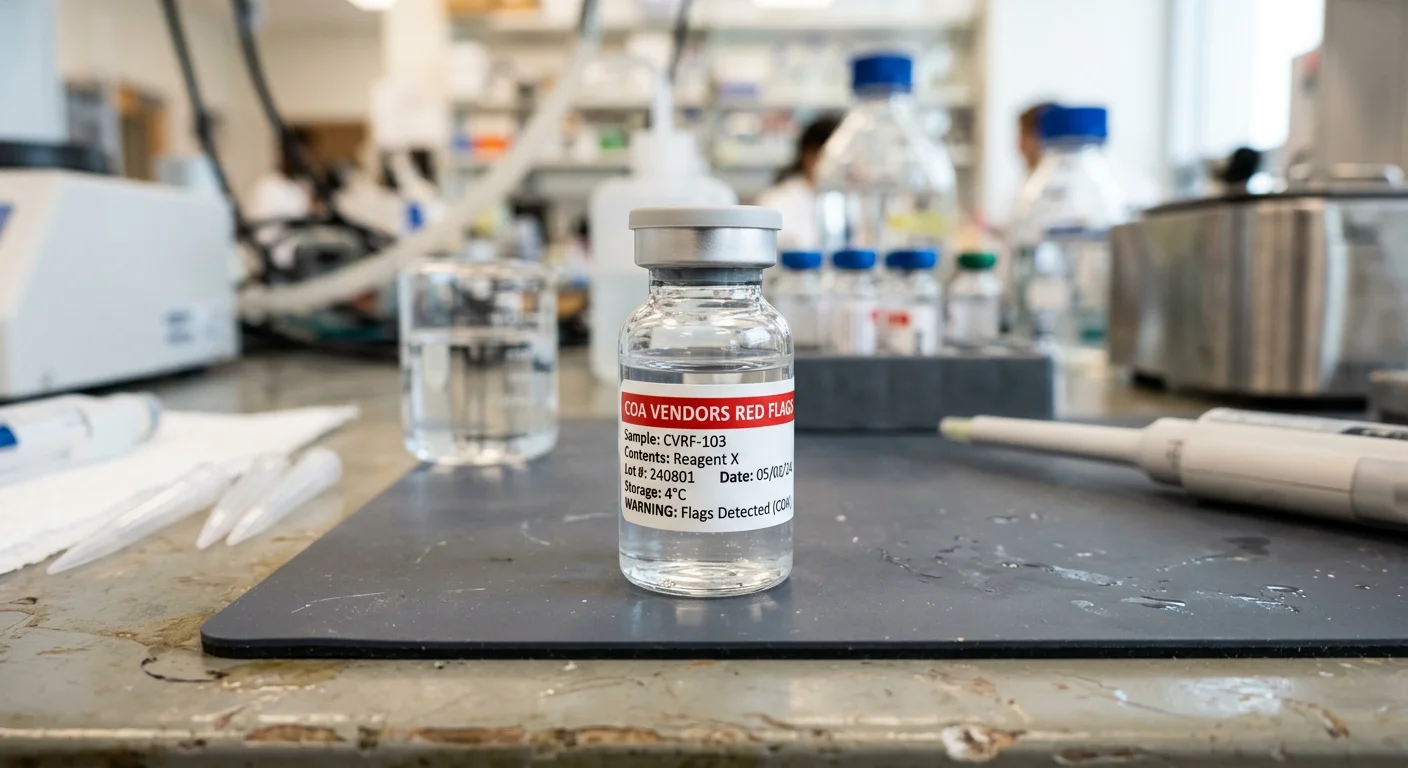
If you’ve already purchased from a single-COA vendor, here’s how to assess what you received:
Step 1: Check the vial label for a batch number. If there’s no batch number, you have no way to verify what you received. The product is untraceable.
Step 2: Request the COA for your specific batch. Email the vendor with your order number and batch number (if visible) and ask for the Janoshik COA corresponding to that batch. If they send you a COA dated months before your purchase, it’s not a match-batch COA.
Step 3: Verify the COA on janoshik.com. If the vendor provides a Janoshik ID, verify it independently. If the ID doesn’t exist or returns different data, the COA is fabricated.
Step 4: Consider third-party testing. If you’re using the peptide for critical research, send a vial to Janoshik yourself. It costs $250-$350 but provides definitive verification. Compare your result to the vendor’s posted COA. If there’s a significant discrepancy (>5% purity difference), the vendor is selling untested or mislabeled product.
Step 5: Switch vendors. Once you’ve identified a single-COA vendor, stop buying from them. The research peptide market has enough legitimate suppliers that you don’t need to accept untested inventory. Bastion Peptides operates on match-batch verification with publicly verifiable COAs. Check the lab results page to see what real batch-matched testing looks like.
For researchers who want to monetize their vendor evaluation work, Bastion Peptides offers an affiliate program that pays commissions on referred sales. If you’re already vetting vendors and recommending sources to colleagues, you can earn from those referrals while directing buyers to a match-batch verified supplier.
Related COA verification guides
Frequently Asked Questions
What is a single-COA peptide vendor?
A single-COA peptide vendor posts one Certificate of Analysis (typically from Janoshik) and reuses it across multiple production batches for months or years. This means customers buying in October may be viewing test results from a batch manufactured in January, with no verification that the current inventory matches the posted COA. Match-batch vendors test every production batch separately and provide COAs that correspond to the specific batch number on the vial you receive.
How do I verify a Janoshik COA independently?
Every legitimate Janoshik COA includes a verification ID (e.g., “240315.1”). Go to janoshik.com, navigate to the test verification page, and enter the ID. Janoshik’s database will return the original test result, date, and sample description. Compare this to the vendor’s posted COA. If the data matches and the test date is recent (within 30-60 days of your purchase), it’s likely a match-batch COA. If the ID doesn’t exist or returns different data, the COA may be fabricated.
Why do batch numbers matter for peptide verification?
Batch numbers link a specific vial to a specific COA. Pharmaceutical manufacturers stamp batch numbers on products and maintain traceability from raw material to end user. For research peptides, the batch number on your vial should match the batch number on the posted COA. If they don’t match, you’re receiving untested product. Vendors who omit batch numbers or use vague labels like “Batch A” are hiding the fact that they’re reusing COAs across multiple production runs.
What purity percentage should I expect from research-grade peptides?
Research-grade peptides typically test between 95-99% purity by HPLC. Purity below 95% suggests low-quality synthesis or degradation. Purity above 99% is rare and often indicates selective reporting (the vendor only posts COAs from their best batches). Normal batch-to-batch variance is 3-8%, so a vendor whose COAs always show exactly 98.5% purity is likely reusing the same test result. Real match-batch testing shows variance: one batch at 97.2%, the next at 98.9%, the next at 96.8%.
Can I trust COAs hosted on a vendor’s website?
Only if they include verifiable Janoshik IDs that you can check on janoshik.com. COAs hosted as PDFs on vendor domains can be altered or fabricated. Some vendors post fake COAs with made-up test results. The only way to confirm authenticity is independent verification through Janoshik’s database. Never trust a COA that can’t be verified externally, and never trust a vendor who refuses to provide Janoshik IDs.
How often should a vendor post new COAs for the same compound?
It depends on order volume and batch size, but most vendors receive new batches every 4-12 weeks. A vendor selling high-volume compounds like Semaglutide or BPC-157 should post new COAs monthly or bimonthly. If a vendor’s COAs for a popular compound are 6-12 months old, they’re operating as a single-COA vendor. For verified compounds, Bastion Peptides posts 2-4 new COAs per compound per quarter as new batches arrive and get tested; compounds still pending their first test are marked as such on the lab results page.
What should I do if the batch number on my vial doesn’t match the COA?
Contact the vendor immediately and request the COA for your specific batch. If they can’t provide it, request a refund. A mismatch between vial batch number and COA batch number means you’re receiving untested product. This is the most definitive red flag for single-COA vendors. If the vendor refuses to provide a matching COA or claims “all batches are the same,” stop buying from them and find a match-batch verified supplier.
Is match-batch verification standard practice in the research peptide industry?
No, which is why buyer education is critical. Most research peptide vendors use single-COA practices to reduce testing costs. Match-batch verification is standard in pharmaceutical manufacturing (GMP requirements mandate batch testing), but the research peptide market operates in a regulatory gray zone with no enforcement. Bastion Peptides adopted match-batch verification as a competitive differentiator and quality standard. In our experience sourcing across multiple manufacturers, vendors who skip batch testing inevitably compromise on quality within 6-12 months. Buyers who demand it will force other vendors to adopt it or lose market share.
Can I send peptides to Janoshik for independent testing myself?
Yes. Janoshik accepts samples from individuals and provides the same HPLC or LC-MS testing they provide to vendors. Costs range from $250-$350 per sample depending on test type. If you’re using peptides for critical research or suspect a vendor is selling untested product, third-party testing provides definitive verification. Compare your result to the vendor’s posted COA. Discrepancies larger than 5% purity indicate the vendor is not providing match-batch verified product.
What is the difference between HPLC and LC-MS testing for peptides?
HPLC (High-Performance Liquid Chromatography) measures purity by separating peptide molecules and quantifying the target peptide versus impurities. It’s the standard test for verifying peptide concentration and purity percentage. LC-MS (Liquid Chromatography-Mass Spectrometry) adds mass spectrometry to confirm molecular weight and identity. LC-MS is more expensive but provides stronger verification that the peptide is actually the compound claimed. Janoshik offers both. For most research purposes, HPLC is sufficient if the vendor is reputable and provides match-batch COAs.
Conclusion: Demand Match-Batch or Walk Away
The single-COA peptide vendor problem is solvable through buyer discipline. Vendors reuse COAs because customers don’t verify them. The solution: verify every COA on janoshik.com, demand batch numbers that match posted COAs, and refuse to buy from vendors who won’t provide match-batch verification. This is not a high bar—it’s the minimum standard for research-grade products.
Bastion Peptides operates on match-batch verification because research integrity requires it. Verified compounds each get their own Janoshik test, with a publicly verifiable COA and a batch number that matches the posted certificate. Compounds still pending their first test are marked as such on the lab results page. If you’re buying peptides for serious research, this is the standard you should demand. Check the lab results page to see what legitimate batch-matched testing looks like, and use it as a reference when evaluating other vendors.
The post-Peptide-Sciences market is fragmented, but it’s also an opportunity to establish higher standards. Vendors who test every batch will survive. Vendors who reuse COAs will lose credibility as buyers get smarter. Choose vendors who verify. Ignore vendors who don’t.
Research Use Only. Not for human consumption.
Common questions? See the Bastion Peptides Help Center, answers on payment, customs reship, Match-Batch lab verification, RUO compounds, and the affiliate program.
Related research guides
- Selank: Tuftsin-Analog Anxiolytic Peptide Research Guide
- Semax: ACTH(4–10) Nootropic Peptide Research Guide
- Semax vs Selank: Nootropic vs Anxiolytic Research Peptides
- PT-141 (Bremelanotide): Melanocortin Research Guide
- Peptide Cold-Chain Shipping: Moisture vs Heat (The Real Risk)