Research-use-only notice
This monograph is provided strictly for research and laboratory use only (RUO). Melanotan II (MT-II) is supplied as a reference material for in vitro study, analytical method development, and controlled non-clinical investigation. It is not a drug, dietary supplement, cosmetic, or tanning product, and nothing on this page constitutes medical advice or authorisation for administration to humans or animals outside an approved research protocol. This guide intentionally omits dosing schedules, reconstitution-for-injection instructions, cosmetic or self-tanning procedures, and any framing that could be read as a safety reassurance. Melanotan II has a well-documented history of recreational misuse; the purpose of this article is to describe its structure and receptor pharmacology accurately so that researchers can evaluate it as an experimental tool, not to facilitate use. Anyone considering work with this compound must comply with their institutional, biosafety, and jurisdictional requirements before handling it.
What Melanotan II is
Melanotan II is a synthetic cyclic analogue of alpha-melanocyte-stimulating hormone (α-MSH), one of the endogenous melanocortin peptides derived from the proopiomelanocortin (POMC) precursor. Where native α-MSH is a linear tridecapeptide that is rapidly degraded by peptidases, MT-II was engineered as a smaller, conformationally constrained heptapeptide that retains the message sequence responsible for melanocortin receptor binding. The reference structure is commonly written as Ac-Nle-c[Asp-His-D-Phe-Arg-Trp-Lys]-NH₂: an acetylated N-terminus, a norleucine (Nle) substitution, and a lactam bridge formed between an aspartate side chain and a lysine side chain that cyclises the molecule. The His-D-Phe-Arg-Trp core preserves the conserved pharmacophore shared by α-MSH and adrenocorticotropic hormone (ACTH).
Two design features explain why this analogue is of interest as a research probe. First, the cyclisation via the lactam bridge rigidifies the backbone into a bioactive conformation, which both increases binding affinity and improves resistance to enzymatic breakdown relative to the linear parent peptide. Second, the D-phenylalanine substitution at the position corresponding to native L-Phe further stabilises the active conformation and contributes to potency. The net result is a metabolically more stable, higher-affinity agonist than α-MSH itself. The product available for laboratory work, Melanotan II, is supplied as a lyophilised powder intended for reconstitution under research conditions only.
Mechanism and pharmacology
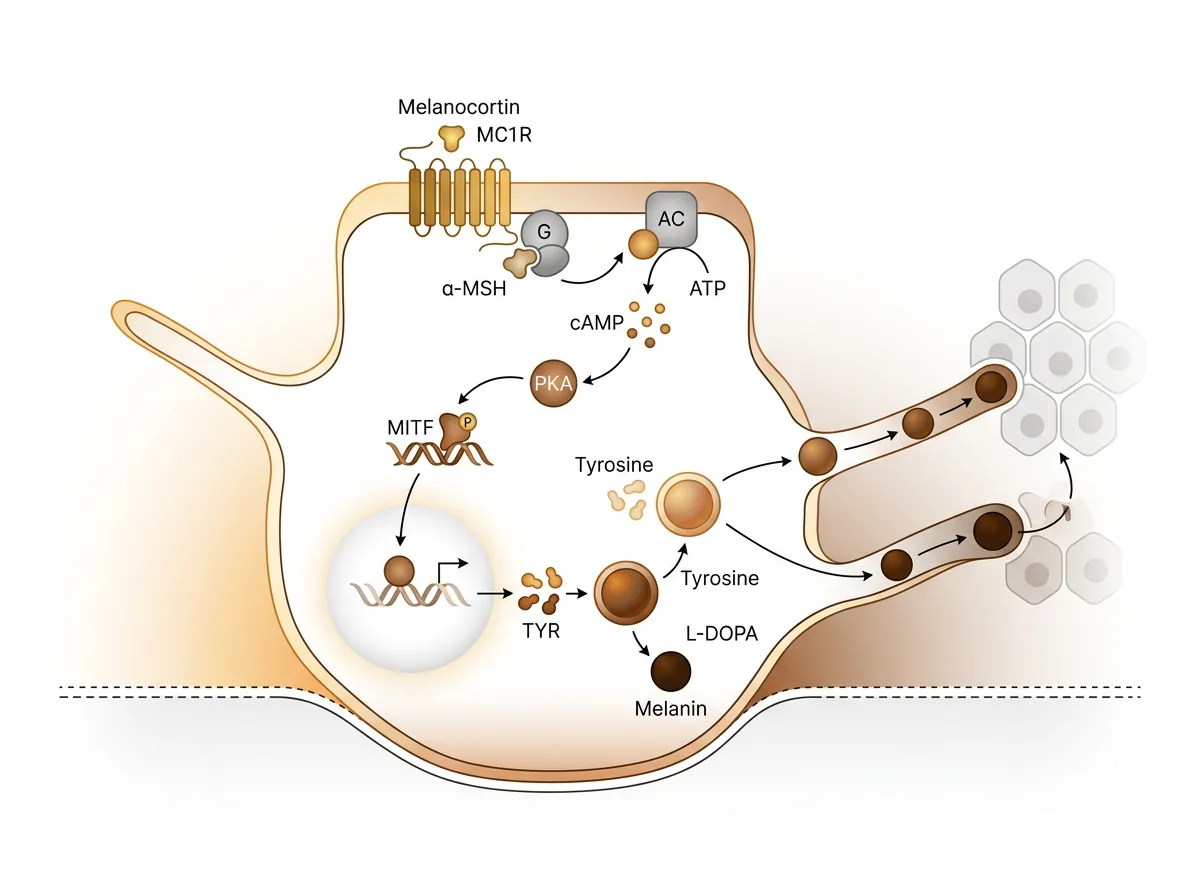
The melanocortin system signals through a family of five G-protein-coupled receptors, designated MC1R through MC5R. These receptors couple predominantly to Gs, so agonist binding activates adenylyl cyclase and raises intracellular cyclic AMP, which in turn drives downstream effector pathways specific to each receptor’s tissue distribution. The five subtypes are not interchangeable: each has a distinct expression pattern and a distinct set of physiological associations in the published literature.
- MC1R is expressed prominently on melanocytes and is associated with melanogenesis — the synthesis of melanin pigment and the eumelanin/pheomelanin switch.
- MC2R is the ACTH receptor of the adrenal cortex and is functionally distinct, responding to ACTH rather than to α-MSH-type ligands.
- MC3R and MC4R are expressed in the central nervous system and are associated in animal models with energy homeostasis, feeding behaviour, and a range of autonomic and behavioural pathways. MC4R in particular is a heavily studied node in appetite and body-weight regulation.
- MC5R is associated in models with exocrine gland function, including sebaceous secretion.
The pharmacologically defining property of Melanotan II is that it is a non-selective melanocortin receptor agonist: it activates MC1R, MC3R, MC4R, and MC5R with substantial affinity rather than confining its action to a single subtype. This broad, high-affinity engagement is precisely what makes MT-II valuable as a laboratory tool for interrogating the melanocortin system as a whole. It’s also what makes it unsuitable as a targeted therapeutic. Because a single molecule simultaneously drives pigmentary (MC1R), central feeding and behavioural (MC3R/MC4R), and glandular (MC5R) pathways, any biological readout in an intact system reflects a mixture of receptor activities rather than a clean, interpretable single-target effect. The contrast between MC1R-associated melanogenesis and MC4R-associated central pathways is the most frequently discussed axis of this non-selectivity, because activating both at once produces overlapping and confounded outputs.
What the research investigates
In a research setting, Melanotan II is used principally as a pan-melanocortin agonist reference compound. It’s a tool to probe how the melanocortin receptor family behaves rather than an endpoint in itself. Several broad lines of investigation appear in the melanocortin literature, and MT-II is relevant to each because of its high affinity and metabolic stability.
Pigmentation and photoprotection biology. Because MC1R activation drives melanin synthesis, MT-II is used in cell-based and animal models to study melanocyte signalling, the regulation of eumelanin production, and the broader question of how the melanocortin pathway modulates pigmentation. This connects to research interest in melanocortin signalling as a potential lever for understanding ultraviolet response and photoprotective biology at the cellular level. It’s a mechanistic question, distinct from any cosmetic application.
Melanocortin receptor pharmacology. MT-II serves as a comparator agonist in binding and functional assays used to characterise newly synthesised ligands, to map structure-activity relationships across the receptor family, and to validate selective agonists and antagonists by reference to a known non-selective standard. Its well-defined, high-affinity profile makes it a useful positive control.
Feeding, energy balance, and behaviour pathways. Through MC3R and MC4R, the melanocortin system is a central regulator of appetite and energy homeostasis in animal models. MT-II is used in such models to probe central melanocortin signalling and its downstream behavioural and autonomic correlates. These are mechanistic, model-system investigations; the literature characterises pathways and receptor involvement, not a validated human intervention.
Across all of these areas, the recurring theme is that MT-II is a mechanistic probe. Its breadth is an asset for asking “what does engaging the melanocortin system do?” and a liability for asking “what does engaging one specific receptor do?” The latter requires selective tools.
Melanotan II versus PT-141 (bremelanotide) and the melanocortin family
Melanotan II and PT-141 (bremelanotide) are closely related but pharmacologically distinct, and the relationship illustrates how medicinal chemistry attempts to convert a broad probe into a more selective tool. PT-141 was developed as a structural derivative of MT-II, a modified analogue in which part of the parent molecule was altered to shift the receptor activity profile. The intent of that modification was to reduce the relatively strong MC1R (pigmentary) component of MT-II and move the balance toward the central MC3R/MC4R receptors. The practical consequence reported in the literature is that PT-141 is comparatively more MC4R-weighted and doesn’t engage MC1R as strongly as MT-II does, which is why MT-II is associated with prominent melanogenic activity while PT-141 is studied primarily in the context of central melanocortin pathways.
Neither compound is truly mono-selective. Both act across multiple melanocortin receptors. But the degree and direction of that non-selectivity differ. MT-II remains the broader pan-agonist, engaging the pigmentary receptor strongly. PT-141 represents a deliberate re-weighting toward the central receptors with reduced pigmentary activity. For researchers, the two compounds are therefore complementary reference tools: MT-II for studying the melanocortin system broadly including its pigmentary arm, and PT-141 for work biased toward the central subtypes. Readers comparing the two should consult the companion PT-141 (bremelanotide) research guide for the corresponding profile.
What the literature does not establish
It is essential to be candid about the boundaries of the published record, because Melanotan II is widely misrepresented.
- There is no established safe human dose. Melanotan II is not an approved drug. The research literature does not define a validated, safe, effective human dosing regimen, and this monograph deliberately provides none.
- Non-selectivity is a fundamental limitation, not a feature to optimise around. Because MT-II simultaneously activates pigmentary, central, and glandular melanocortin receptors, its actions in any intact organism are inherently mixed and difficult to attribute to a single pathway. This is the core scientific reason it is regarded as a research probe rather than a human product: a compound that engages four receptor subtypes at once cannot deliver a clean, targeted effect.
- Mechanistic and animal-model findings do not translate into human-use conclusions. Demonstrating that MT-II activates a receptor or modulates a pathway in a model system says nothing about safety, efficacy, or appropriateness in humans. Those gaps are not minor caveats; they are the reason the compound remains experimental.
- This article makes no safety reassurance. Absence of a stated hazard here is not evidence of safety. The recreational misuse history of this peptide underscores that the compound’s effects in humans are not characterised in a way that supports use.
In short, the literature supports MT-II as a tool for studying melanocortin pharmacology and does not support it as a finished, targeted, or human-ready agent.
Handling, reconstitution, and stability
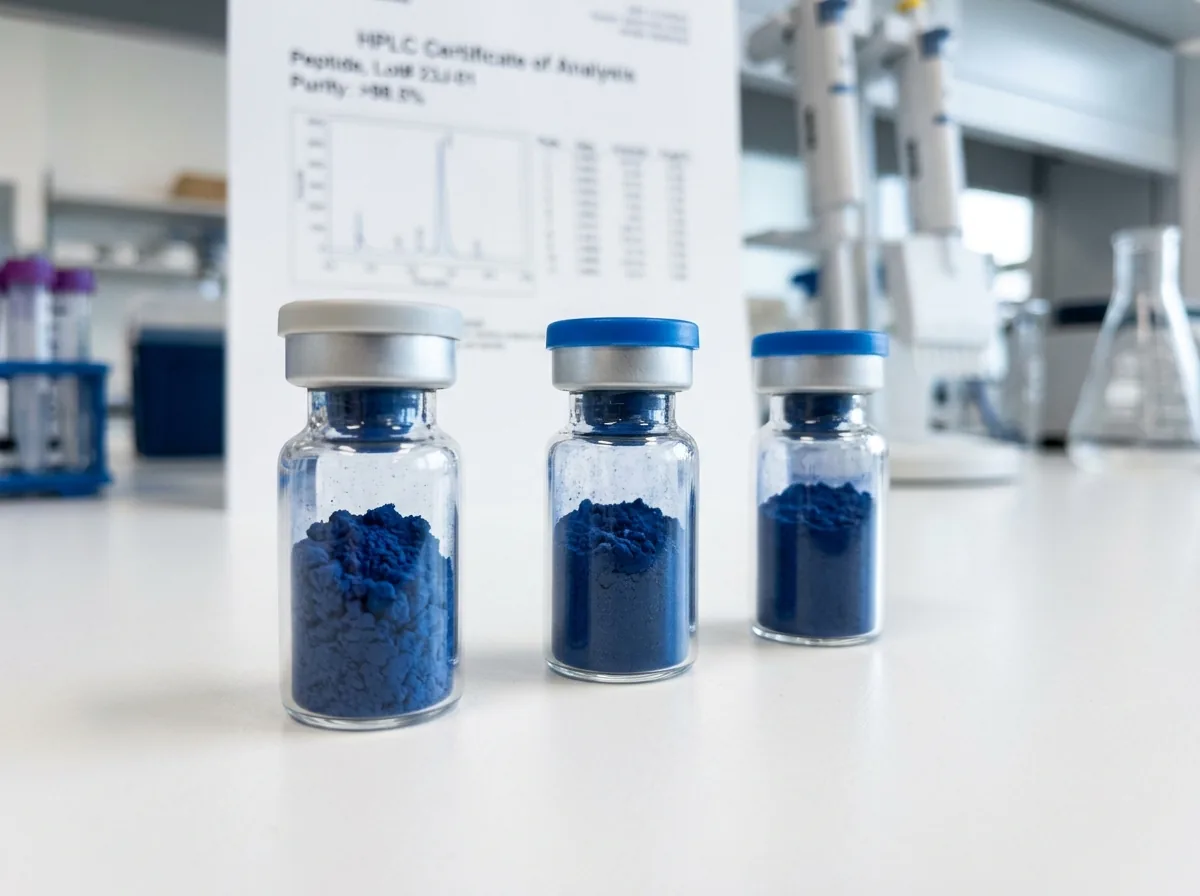
Melanotan II is typically supplied as a lyophilised (freeze-dried) powder, the standard physical form for research peptides because it maximises shelf stability. General laboratory handling principles for peptides of this class apply, framed strictly for bench work:
- Storage of lyophilised material: the dry powder is generally most stable when kept cold and protected from light and moisture, with long-term storage at freezer temperatures. Allow sealed vials to equilibrate toward room temperature before opening to limit condensation onto the hygroscopic solid.
- Reconstitution for laboratory assays: peptides of this type are commonly brought into solution with a suitable research-grade diluent appropriate to the assay. Solubilisation should be gentle. Swirl rather than shake vigorously, and direct diluent down the vial wall rather than onto the powder, to avoid mechanical stress on the peptide.
- Post-reconstitution stability: once in solution, peptides are markedly less stable than the dry form. Reconstituted material is generally kept refrigerated, used within a limited working window, and protected from repeated freeze-thaw cycles, which degrade peptide integrity. Aliquoting before freezing is a common practice to avoid repeated thawing of a single stock.
For working out concentrations and volumes for an experimental stock, our peptide reconstitution calculator guide walks through the arithmetic. These notes describe general peptide-handling practice for laboratory preparation and are not instructions for preparing material for administration.
Verifying purity and identity
For any research material, the data package matters as much as the molecule, because conclusions drawn from an impure or misidentified compound are unreliable. Two questions should be answerable for every vial: is it the correct peptide (identity) and how pure is it (the proportion of the stated compound versus impurities, truncated sequences, or residual synthesis by-products).
The standard analytical approach combines high-performance liquid chromatography (HPLC) for a purity percentage with mass spectrometry to confirm that the measured molecular mass matches the expected mass of the target sequence. Independent, third-party verification is preferable to a vendor’s unsupported claim, and a meaningful per-lot Certificate of Analysis (COA) should correspond to the specific batch in hand rather than to a generic representative result. Our published lab results and the Janoshik match-batch verification process are intended to let researchers tie a physical vial to its analytical data. For guidance on interpreting these documents, reading the chromatogram, the purity figure, and the mass confirmation, see our walkthrough on how to read a peptide COA.
Frequently asked questions
Is Melanotan II receptor-selective?
No. MT-II is a non-selective melanocortin agonist that activates MC1R, MC3R, MC4R, and MC5R with substantial affinity. This breadth makes it a useful general probe of the melanocortin system but means that any effect observed in an intact system reflects mixed receptor activity rather than a single, cleanly attributable target.
How does it differ from PT-141 (bremelanotide)?
PT-141 is a structural derivative of MT-II that was modified to shift its receptor profile away from the pigmentary MC1R receptor and toward the central MC3R/MC4R receptors. As a result, PT-141 is comparatively more MC4R-weighted and engages MC1R less strongly, whereas MT-II retains prominent MC1R activity. Both remain non-selective; they differ in the balance of that non-selectivity.
Why is MT-II considered a research probe rather than a product?
Because it activates four melanocortin receptor subtypes simultaneously, MT-II cannot produce a targeted, single-pathway effect. That same non-selectivity, combined with the absence of an established safe human dose in the literature, is why it is appropriate as a laboratory tool but not as a finished agent for human use.
What form does it ship in, and how is it stored?
It is supplied as a lyophilised powder. The dry powder is generally stored cold, dark, and dry, with long-term storage at freezer temperatures; once reconstituted for an assay it is far less stable and is kept refrigerated, used within a short window, and protected from repeated freeze-thaw cycles.
How can identity and purity be confirmed?
Through independent HPLC for purity together with mass spectrometry for identity, documented on a per-lot Certificate of Analysis tied to the specific batch. Third-party verification and batch-matching are preferable to a generic or unsupported purity claim.
Summary
Melanotan II is a synthetic cyclic lactam analogue of α-MSH, the heptapeptide Ac-Nle-c[Asp-His-D-Phe-Arg-Trp-Lys]-NH₂, whose cyclisation and D-Phe substitution confer high affinity and metabolic stability relative to the native peptide. Its defining pharmacological property is non-selective agonism across the melanocortin receptor family (MC1R–MC5R), with MC1R activation associated with melanogenesis and MC3R/MC4R associated with central feeding and behavioural pathways in animal models. That breadth makes MT-II a valuable mechanistic probe of melanocortin pharmacology and the very reason it’s unsuitable as a targeted human product. It is related to but distinct from PT-141 (bremelanotide), a derivative re-weighted toward the central receptors. The literature does not establish a safe human dose, and this material is offered for research use only, with identity and purity to be confirmed by independent HPLC and a per-lot COA before any experimental work.