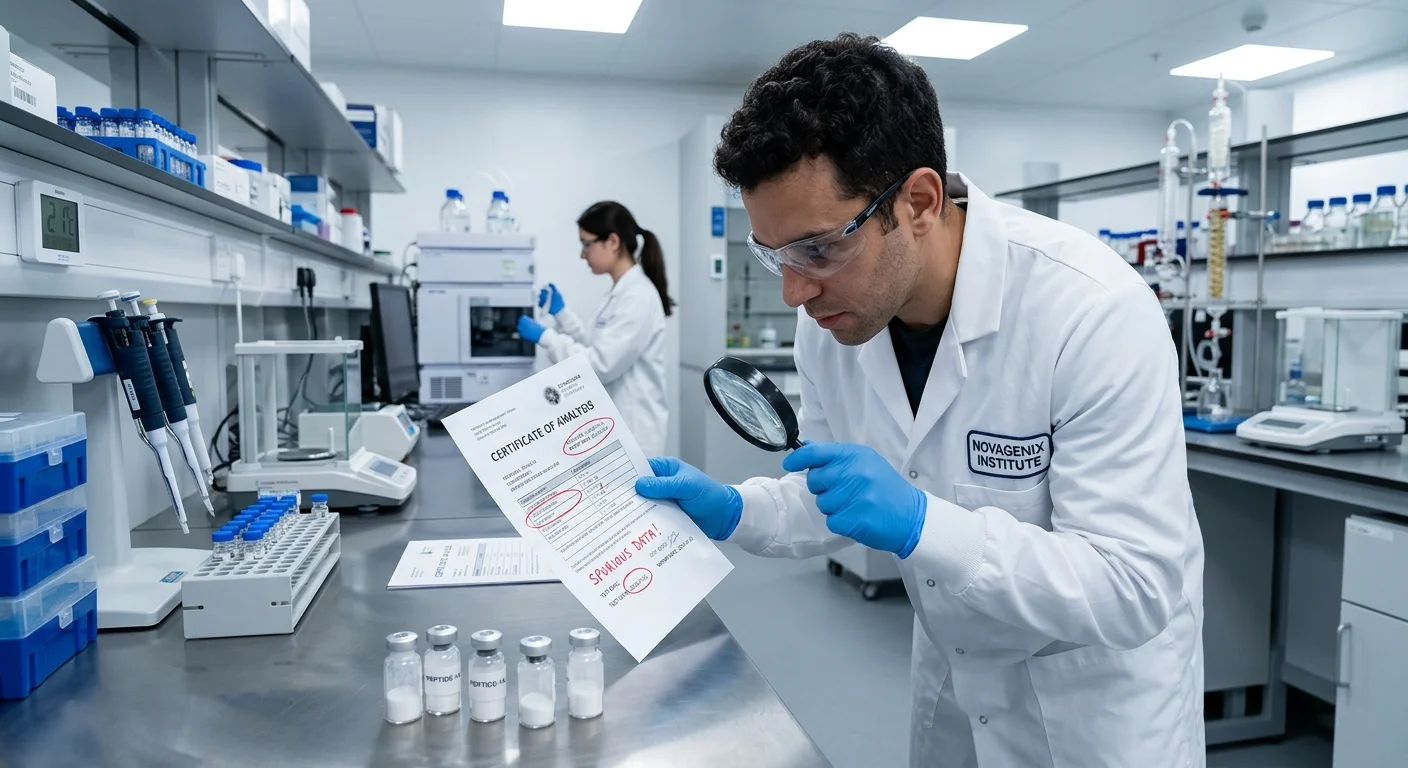
The research peptide market operates in a regulatory gray zone where verification infrastructure is sparse and fraud is rampant. After the 2024-2025 wave of vendor closures, including Peptide Sciences’ shutdown, thousands of researchers migrated to new suppliers, many of which present fabricated or manipulated Certificates of Analysis. A fake peptide COA can mean anything from relabeled lyophilized powder to outright substitution with cheaper compounds. For researchers conducting serious in vitro or preclinical work, a fraudulent COA doesn’t just waste money, it invalidates months of experimental data. This guide walks through seven forensic red flags that distinguish legitimate third-party verification from vendor theater, with specific focus on Janoshik verification protocols and match-batch testing standards.
Red Flag #1: The COA Lives Only on the Vendor’s Domain
Legitimate third-party testing labs publish results on their own infrastructure. Janoshik, the most-cited peptide verification lab in the research community, hosts all authentic reports at janoshik.com with unique alphanumeric identifiers. If a vendor shows you a PDF on their own server (bastionpeptides.com/coa/xyz.pdf, for example) without a corresponding janoshik.com verification link, you’re looking at an unverifiable document. The vendor controls the file. They can edit it at will. They can recycle one legitimate test across fifty product batches.
Bastion Peptides publishes match-batch COAs with direct Janoshik verification links on the lab results page for compounds that have completed testing, each verified batch gets a separate test, and each test links back to janoshik.com for independent confirmation. Compounds still pending testing are listed separately on that page. This is the standard. Anything less is vendor self-attestation masquerading as third-party verification.
Verification protocol: Copy the report ID from the COA. Navigate to janoshik.com. Search the ID in their database. If the report doesn’t exist or the parameters don’t match (compound name, purity percentage, test date), you’re holding a fake peptide COA.
Red Flag #2: Recycled Batch Numbers Across Multiple Compounds
A batch number identifies a specific production run. One batch = one synthesis event = one COA. If you see the same batch number (e.g., BP-20241015-A) attached to Semaglutide, BPC-157, and Tirzepatide, the vendor is recycling test results. This is logistically impossible in legitimate manufacturing. Each compound requires distinct synthesis pathways, purification protocols, and lyophilization parameters. They cannot share a batch identifier unless the vendor is simply inventing numbers.
Check multiple product pages on a vendor’s site. Note the batch numbers in the COA images or PDFs. If batch identifiers repeat across chemically unrelated compounds, or if the same COA appears on products restocked months apart, the vendor is operating a COA theater, showing you one legitimate test while shipping untested or substitute material.
| Legitimate Practice | Recycling Red Flag |
|---|---|
| Batch BP-GLP1-030125 → Semaglutide only | Batch BP-030125 → Semaglutide, Tirzepatide, Retatrutide |
| New batch every 2-4 weeks per compound | Same batch number for 6+ months |
| Janoshik report ID changes per batch | One Janoshik ID across multiple SKUs |
Red Flag #3: HPLC Purity Without LC-MS Identity Confirmation
HPLC (High-Performance Liquid Chromatography) measures purity, what percentage of the sample is the target peptide versus impurities. LC-MS (Liquid Chromatography-Mass Spectrometry) confirms identity, is the peptide actually the molecule claimed, or is it a structural analog or entirely different compound? A fake peptide COA often shows HPLC results (easy to fabricate, hard for buyers to verify) without LC-MS confirmation (expensive to fake, requires actual mass spectrometry equipment).
Janoshik’s standard peptide panel includes both HPLC purity and LC-MS identity verification. If a vendor’s COA shows 98.7% purity but no molecular weight confirmation, no fragmentation pattern, and no mass spectrum graph, you’re missing half the verification. This is the signature of vendors who source from Chinese suppliers that provide HPLC-only testing (or who fabricate the numbers entirely).
Preclinical researchers have documented cases where HPLC-only COAs showed 99%+ purity, but LC-MS revealed the compound was a cheaper peptide analog or even a completely unrelated molecule with similar chromatographic behavior. Without mass spectrometry, you’re trusting the vendor’s label, not verifying the molecule.
Red Flag #4: Suspiciously Perfect Purity Numbers
Real peptide synthesis produces impurities. Even pharmaceutical-grade GMP facilities rarely exceed 99.5% purity on complex peptides. If a vendor consistently shows 99.8%, 99.9%, or 100.0% purity across multiple compounds and batches, the numbers are fabricated. Peptide synthesis generates deletion sequences (missing amino acids), truncations, and acetylated or oxidized variants. These show up in HPLC as secondary peaks. A 100% purity result means either the testing method is inadequate or the numbers are invented.
Legitimate COAs from Janoshik typically show purity ranges of 96-99% for research-grade peptides. Tirzepatide, for example, commonly tests at 97.2-98.5% due to its complex 39-amino-acid sequence and dual GLP-1/GIP agonism requiring precise folding. Semaglutide (31 amino acids, fatty acid modification) often lands at 97.8-98.9%. If a vendor shows 99.9% across the board, they’re either rounding up, cherry-picking one exceptional batch and recycling the COA, or fabricating the data.
Red Flag #5: Missing or Generic Endotoxin Testing
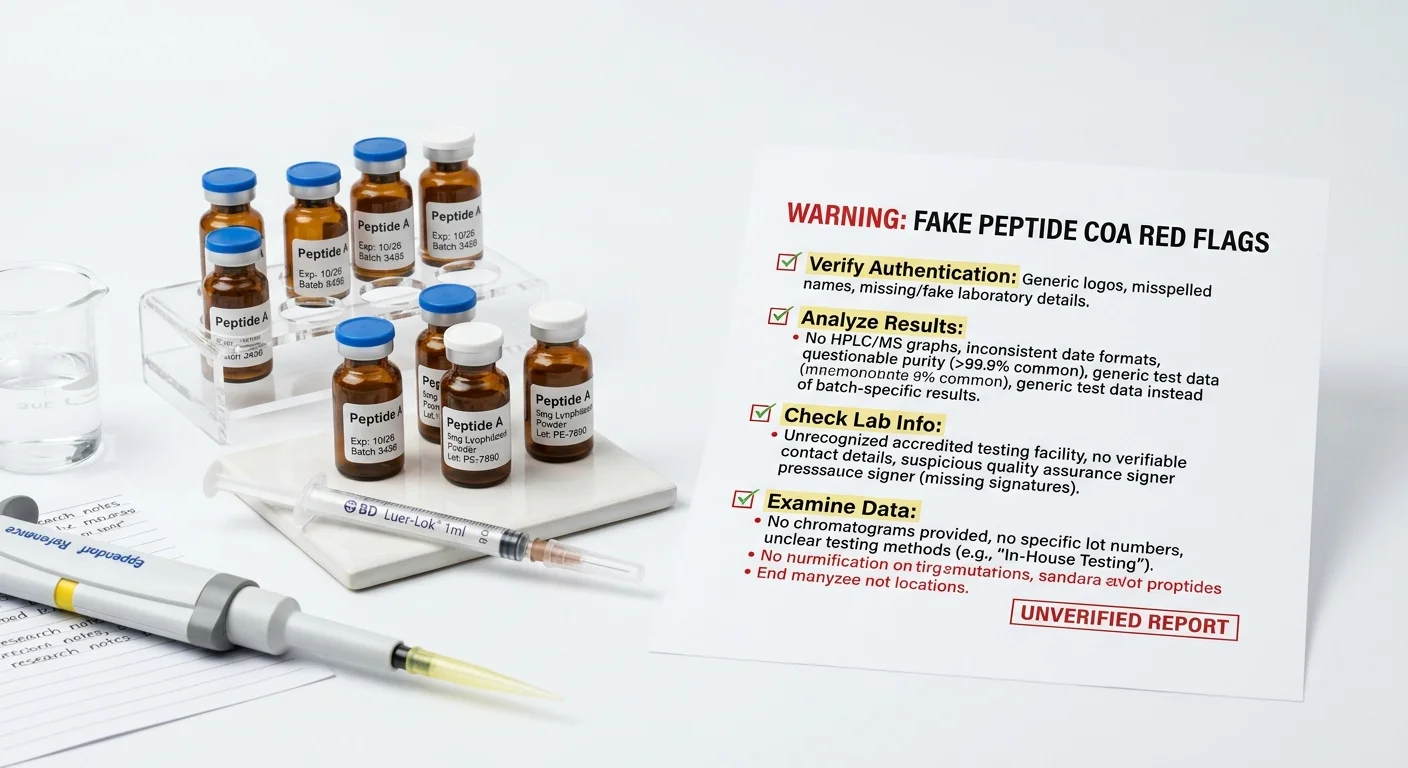
Endotoxin contamination (bacterial lipopolysaccharides) is a critical quality parameter for any peptide intended for in vivo research. Even RUO-designated peptides require endotoxin testing because contamination can skew experimental results in cell culture and animal models. Legitimate vendors include LAL (Limulus Amebocyte Lysate) endotoxin assay results in their COAs, typically reporting in EU/mg (Endotoxin Units per milligram).
A fake peptide COA either omits endotoxin data entirely or shows a generic ‘Pass’ without numerical values. Janoshik’s peptide testing panel includes quantitative endotoxin results (e.g., ‘<0.5 EU/mg' or '0.12 EU/mg'). If the COA you're reviewing shows no endotoxin line item, or if it says 'Endotoxin: Negative' without units or methodology, the vendor is skipping this test or fabricating compliance.
For researchers conducting in vitro cytokine assays or in vivo metabolic studies, endotoxin contamination can trigger inflammatory responses that confound results. A vendor selling peptides without verified endotoxin testing is selling uncontrolled variables, not research compounds.
Red Flag #6: Impossible Test Turnaround Times
Janoshik’s standard peptide panel (HPLC, LC-MS, endotoxin) requires 7-10 business days from sample receipt to published results. If a vendor claims they received a new batch on March 1st and have a Janoshik COA dated March 2nd, the timeline is physically impossible. This indicates either the COA is from an old batch (and they’re recycling it for new inventory), or the COA is fabricated.
Cross-reference the test date on the COA with the vendor’s restock announcements or batch production dates if disclosed. Legitimate vendors operating on match-batch protocols, like Bastion Peptides’ approach detailed on the lab results page, will show a logical timeline: production date → sample shipment to lab → test completion → COA publication → product listing. If these events compress into 24-48 hours, the vendor is either skipping testing or recycling old reports.
Red Flag #7: No Third-Party Lab Accreditation or Methodology Disclosure
Janoshik operates under ISO 17025 accreditation, the international standard for testing and calibration laboratories. Their COAs include methodology descriptions (HPLC column type, mobile phase composition, LC-MS ionization mode, mass range scanned). A fake peptide COA often shows results without methodology, just numbers in a table with no explanation of how those numbers were generated.
If the COA you’re reviewing doesn’t specify the HPLC column (e.g., ‘C18 reversed-phase, 4.6mm x 250mm’), the detection wavelength (e.g., ‘214nm UV’), or the LC-MS ionization method (e.g., ‘ESI positive mode’), you’re looking at a document designed to look scientific without providing verifiable technical detail. Legitimate labs publish methodology because peer review and replication require it. Fraudulent vendors omit methodology because including it would expose the fabrication to scrutiny from researchers who understand analytical chemistry.
Check if the testing lab has a public website with accreditation certificates, published methodologies, and contact information. Janoshik publishes their ISO 17025 certificate and testing SOPs openly. If the ‘lab’ listed on a COA has no web presence, no accreditation documentation, or operates exclusively through the vendor’s domain, it’s not a real third-party lab, it’s a vendor’s internal branding exercise.
How to Verify a COA Before Purchase
Verification is a three-step process. First, identify the testing lab. Navigate to their official domain (janoshik.com for Janoshik reports, chromadex.com for ChromaDex, etc.). Second, locate the report ID on the COA, usually a alphanumeric string like ‘JAN-2025-12345’. Third, search that ID in the lab’s public database. If the report exists and the parameters match (compound name, purity, test date, client name if disclosed), the COA is legitimate for that specific batch.
Next, verify the batch number on the product you’re purchasing matches the batch number on the COA. If the vendor shows you a COA for batch BP-GLP1-030125 but ships you a vial labeled BP-GLP1-040125, you received untested product. Legitimate vendors like Bastion Peptides implement match-batch protocols where every tested production run gets a unique identifier and a corresponding unique COA. This is the standard for vendors serving researchers who actually run their own verification protocols.
Finally, check the timeline. When was the COA dated? When did the vendor restock the product? If the COA is 6 months old but the vendor claims ‘fresh batch just arrived’, either they’re lying about the batch age or they’re recycling the COA. For researchers conducting multi-month studies, peptide degradation over time is a real concern. A 6-month-old batch stored improperly (temperature excursions, humidity exposure) will not match the purity shown on a day-zero COA.
Why Match-Batch Testing Matters for Research Integrity
A single COA reused across multiple batches is not verification, it’s marketing. Peptide synthesis is not a deterministic process. Each production run introduces batch-to-batch variability in purity, impurity profiles, and peptide content. A vendor who tests one batch and then ships five subsequent batches without retesting is asking you to assume consistency that chemistry does not guarantee.
Match-batch testing means every production batch undergoes independent third-party analysis before it ships. This is the protocol pharmaceutical manufacturers use under GMP regulations. Research peptide vendors are not regulated under GMP, but researchers conducting serious preclinical work require the same level of batch control. If your experimental protocol involves dosing calculations based on peptide content (mg of active peptide per vial), and the vendor’s actual content varies ±15% from the COA because they’re recycling old test results, your dose-response curves are invalid.
Bastion Peptides operates on match-batch verification specifically to address this problem. Each batch listed on the lab results page corresponds to a unique Janoshik report, verifiable independently. This is not a premium feature, it’s the baseline standard for vendors serving researchers who understand analytical chemistry.
What to Do If You Suspect a Fake Peptide COA
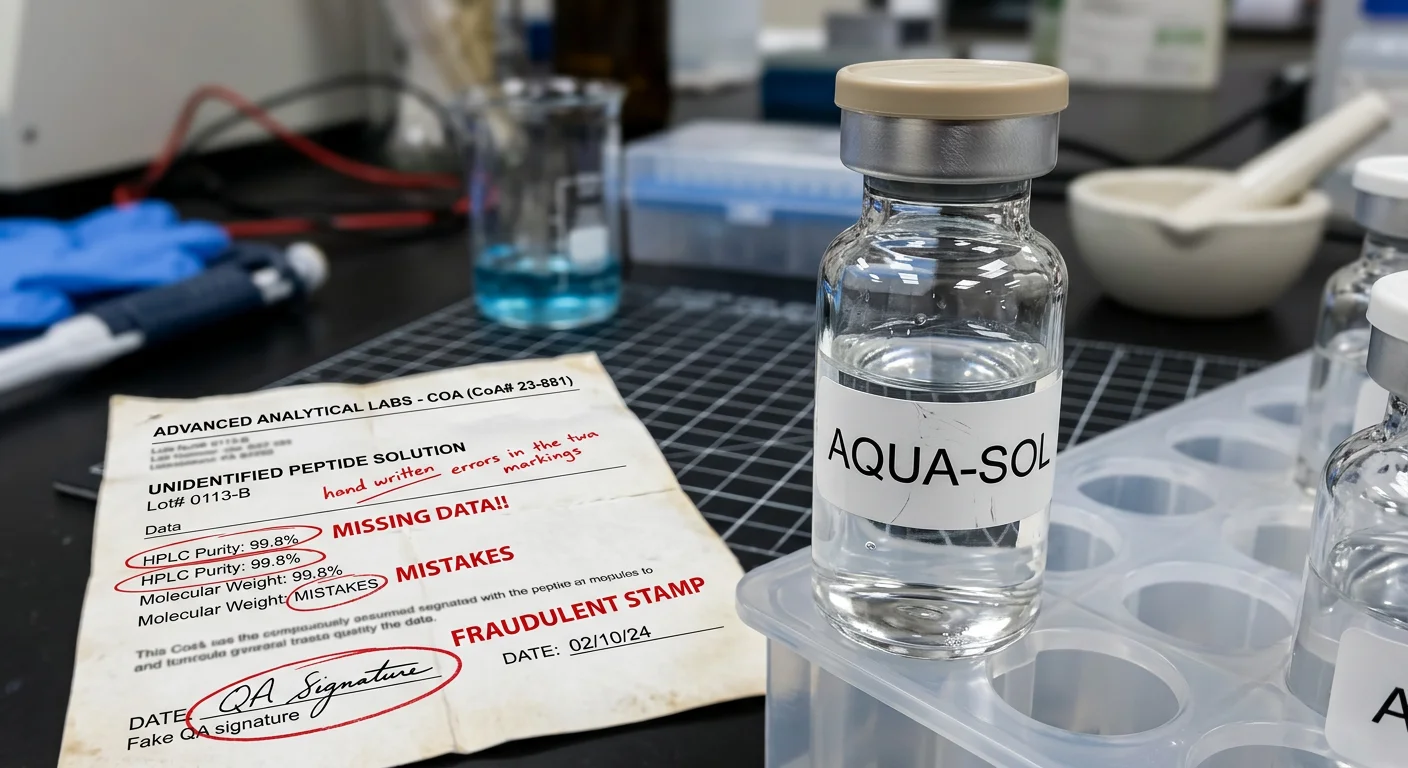
If you’ve already purchased and suspect the COA was fraudulent, document everything. Screenshot the product page, the COA, the batch number on the vial, and the vendor’s claims. Attempt to verify the COA through the testing lab’s official website. If verification fails (report ID doesn’t exist, parameters don’t match, timeline is impossible), you have evidence of fraud.
Post your findings in research peptide communities (Reddit’s r/Peptides, Peptide Forum, biohacking Discord servers) with screenshots and verification attempts documented. The research peptide market is small and reputation-driven. Vendors who consistently get exposed for fake COAs lose their customer base quickly. Your documentation helps other researchers avoid the same vendor.
For future purchases, prioritize vendors who publish match-batch COAs with direct third-party verification links. Avoid vendors who host COAs exclusively on their own domains, who recycle batch numbers, or who show suspiciously perfect purity numbers. The additional cost of legitimate testing (Janoshik charges $150-300 per peptide panel) is marginal compared to the cost of invalidated research or, worse, adverse events in animal models from contaminated or mislabeled compounds.
The Economics of COA Fraud
Why do vendors fake COAs? The economics are straightforward. Legitimate third-party testing costs $150-300 per batch per compound. A vendor selling ten peptide SKUs with monthly restocks pays $18,000-36,000 annually in testing costs. A fraudulent vendor pays zero and pockets the difference. For low-volume vendors operating on thin margins, the temptation is significant.
The risk calculus shifted after Peptide Sciences’ shutdown. Thousands of researchers who previously relied on one trusted vendor suddenly needed new sources. Opportunistic vendors flooded the market, many with no testing infrastructure and no intention of building one. They copy legitimate COAs from other vendors, change the batch numbers in Photoshop, and host the PDFs on their own servers. The fraud is trivial to execute and, until recently, difficult for buyers to detect.
Legitimate vendors absorb the testing cost because their customer base verifies COAs and because reputation is their only moat in a market with no regulatory oversight. Bastion Peptides’ business model depends on researchers who actually navigate to janoshik.com and confirm the report IDs. The affiliate program is structured to reward researchers who refer other verification-conscious buyers, not volume buyers who don’t check COAs. This creates a selection effect: the customer base self-selects for COA literacy, which in turn forces the vendor to maintain match-batch standards or lose the entire business.
Related COA verification guides
- What Match-Batch verification means
- How to spot single-COA vendors
- How to verify a peptide COA on Janoshik in 60 seconds
Frequently Asked Questions
Can I trust a COA that’s hosted on the vendor’s website?
Only if the COA includes a verifiable third-party lab report ID that you can independently confirm on the lab’s official domain. A PDF on the vendor’s server is not third-party verification, it’s a document the vendor controls and can edit at will. Always verify the report ID on janoshik.com or the testing lab’s official site.
What’s the difference between HPLC and LC-MS testing?
HPLC measures purity, the percentage of the sample that is the target peptide versus impurities. LC-MS confirms identity, whether the molecule is actually the peptide claimed, using mass spectrometry to verify molecular weight and structure. A legitimate COA includes both. HPLC-only testing cannot detect if you’ve been shipped a different peptide with similar chromatographic properties.
How often should a vendor retest the same compound?
Every production batch requires a new test. A batch is a single synthesis run, typically 50-500 vials depending on vendor scale. If a vendor restocks a compound monthly, they should have monthly COAs with unique batch identifiers. A vendor reusing the same COA for 6+ months is either not restocking (selling old inventory) or not retesting new batches.
What purity percentage should I expect for research-grade peptides?
Legitimate research-grade peptides typically test at 96-99% purity. Complex peptides like Tirzepatide (39 amino acids) often land at 97-98.5%. Simpler peptides like BPC-157 (15 amino acids) may reach 98-99%. Purity above 99.5% is rare and should be viewed skeptically unless the COA includes detailed impurity profiling showing where the remaining 0.5% went.
What are endotoxins and why do they matter for research peptides?
Endotoxins are bacterial lipopolysaccharides that contaminate peptides during synthesis or handling. Even trace amounts (>1 EU/mg) can trigger inflammatory responses in cell culture and animal models, confounding experimental results. Legitimate COAs include quantitative endotoxin testing using LAL assays, reporting in EU/mg units. A COA without endotoxin data is incomplete.
Can a vendor fake a Janoshik report ID?
They can invent a fake ID, but you’ll discover the fraud when you search it on janoshik.com and find no matching report. Some vendors use real Janoshik IDs from other vendors’ tests or from old batches they once tested. This is why you must verify not just that the ID exists, but that the compound name, purity, and test date match the vendor’s claims.
What should I do if a vendor refuses to provide a COA before purchase?
Walk away. Any vendor selling research peptides without published COAs is asking you to trust them blindly. In a market with no regulatory oversight, COAs are the only verification mechanism available. A vendor who won’t provide COAs either has no testing or has testing results they don’t want you to see (low purity, contamination, wrong compound).
Is it normal for purity to vary between batches of the same peptide?
Yes. Peptide synthesis is not deterministic. Batch-to-batch purity variation of ±1-2% is normal. If a vendor shows identical purity (e.g., 98.7%) across five consecutive batches, they’re likely recycling one COA. Legitimate match-batch testing will show variation: 97.8%, 98.2%, 97.5%, 98.6%, etc.
How do I verify the testing lab itself is legitimate?
Check for ISO 17025 accreditation (the international standard for testing labs), a public website with published methodologies, and contact information (phone, email, physical address). Janoshik publishes their ISO certificate openly and lists their methodologies in detail. If the ‘lab’ on a COA has no web presence or only exists as a subdomain on the vendor’s site, it’s not a real third-party lab.
What’s the risk of using peptides with fake COAs in research?
Experimental invalidation. If the peptide is mislabeled (you think you’re dosing Semaglutide but it’s actually a cheaper analog), your dose-response data is meaningless. If the purity is lower than claimed (COA says 98%, actual is 85%), your mg/kg calculations are wrong. If endotoxin contamination exists, your in vivo results are confounded by inflammatory responses. Fake COAs don’t just waste money, they waste months of research time.
Conclusion: COA Verification as Research Discipline
The research peptide market operates without FDA oversight, without GMP requirements, and without enforcement mechanisms for fraud. COA verification is not optional, it’s the only quality control researchers have. A fake peptide COA can invalidate months of experimental work, waste grant funding, and in worst-case scenarios, introduce uncontrolled variables into in vivo studies. The seven red flags outlined here, vendor-hosted COAs, recycled batch numbers, missing LC-MS, impossible purity, absent endotoxin data, timeline inconsistencies, and undisclosed methodology, are forensic markers that distinguish legitimate third-party verification from vendor theater.
Researchers who verify COAs independently, who cross-reference batch numbers with Janoshik report IDs, and who demand match-batch testing are not being paranoid, they’re practicing basic experimental discipline. The vendors who survive in this market long-term are the ones whose customer base actually checks their work. For researchers seeking stable, verification-conscious suppliers post-Peptide-Sciences, the standard is clear: match-batch COAs, third-party verification links, and transparent testing protocols. Anything less is asking you to trust chemistry that doesn’t care about your trust.
Research Use Only. Not for human consumption.
Related research guides
- Match-Batch vs Pooled Testing: A 2026 Vendor Audit
- Vendor COA vs Independent Testing: What’s the Difference?
- Peptide Sciences Alternatives: Where Researchers Are Buying Now (2026)
- Wholesale vs Retail Research Peptides: Pricing, MOQs & Margins
For verified third-party test results from an actual vendor, see Bastion’s Lab Results archive.