Overview
The choice of reconstitution solvent directly affects peptide stability, usable shelf life, and experimental validity. Bacteriostatic water and sterile water are the two primary options for research peptide reconstitution, and selecting the correct one is not merely a matter of preference — it has measurable consequences for compound integrity over time.
Bacteriostatic Water (BW)
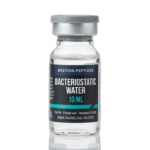
Bacteriostatic water is sterile water for injection containing 0.9% benzyl alcohol (9 mg/mL) as an antimicrobial preservative. Benzyl alcohol inhibits microbial growth without sterilizing — it does not kill all organisms present but prevents multiplication to levels that would compromise research integrity. This allows the reconstituted solution to be drawn from multiple times over weeks without sterility failure.
Advantages:
- Extended post-reconstitution stability (3–6 weeks at 4°C for most peptides)
- Multi-draw capability from a single vial without contamination risk
- Standard of practice for research-grade peptide reconstitution
- Available in 10mL multi-use vials from Bastion Peptides — cost-effective for active laboratories
Limitations:
- Benzyl alcohol can denature proteins or affect some enzyme-linked assays — confirm compatibility with the specific research assay
- Not suitable for neonatal or newborn animal models (benzyl alcohol toxicity at high cumulative doses)
- Slight pH effect (pH ~5.7) may affect pH-sensitive peptides — check peptide pI against solvent pH
Sterile Water for Injection (SWFI)
Sterile water for injection is pyrogen-free, distilled water with no additives. It is appropriate when a single-use reconstitution is planned, when benzyl alcohol compatibility is a concern, or when the assay system is sensitive to preservatives.
Advantages:
- No preservative — eliminates benzyl alcohol as a variable in sensitive assays
- Neutral pH (~7.0) — better for pH-sensitive reconstitutions
- Appropriate when single-use administration is planned immediately
Limitations:
- Short post-reconstitution stability: 24–48 hours at 4°C without benzyl alcohol protection
- Single-draw recommended — each needle puncture of the septum introduces contamination risk
- Not suitable for protocols requiring reconstituted solution over multiple days or weeks
Decision Table
| Situation | Recommended solvent |
|---|---|
| Multi-dose vial, used over 2–6 weeks | Bacteriostatic water |
| Single acute experiment, same day use | Either (sterile water sufficient) |
| Enzyme or cell assay sensitive to benzyl alcohol | Sterile water |
| IGF-1 LR3 or poorly soluble peptide | 0.1% acetic acid in sterile water (initial), then dilute in BW or buffer |
| Neonatal/newborn animal model | Sterile water (avoid benzyl alcohol) |
| Standard subcutaneous dosing in adult rodents | Bacteriostatic water |
Storage After Reconstitution
Regardless of solvent, all reconstituted peptide solutions should be stored at 4°C (standard laboratory refrigerator), protected from light where indicated (Melanotan II, GHK-Cu, PT-141), and labeled with peptide name, concentration, solvent, and date of reconstitution. Discard any solution that becomes cloudy, develops particulates, or exceeds its stability window.
For long-term storage of reconstituted solutions beyond the 4°C stability window, aliquot into single-use volumes and freeze at −20°C. Avoid repeated freeze-thaw cycles — maximum 3 cycles for most research peptides.
Research Disclaimer: All protocols described are intended for qualified laboratory researchers working with research-grade peptides. This content does not constitute medical advice. Bastion Peptides products are for research purposes only and are not approved for human use or therapeutic application.