Knowing how to store research peptides is the difference between a material that performs as characterized and one that has quietly degraded into a mixture of the intended sequence and its breakdown products. Peptides are not inert powders. They are reactive organic molecules subject to hydrolysis, oxidation, deamidation, and aggregation, and the rate of every one of those reactions is governed by storage conditions. The encouraging part is that almost all of this degradation is preventable. Temperature, moisture, light, and the number of times a vial is frozen and thawed account for the overwhelming majority of avoidable losses. None of those variables requires specialized equipment to manage, only a consistent procedure applied from the moment a vial arrives. This guidance covers lyophilized and reconstituted research materials, the conditions that preserve them, and the handling habits that keep a research peptide usable for as long as its chemistry allows. All material discussed here is for laboratory research use only.
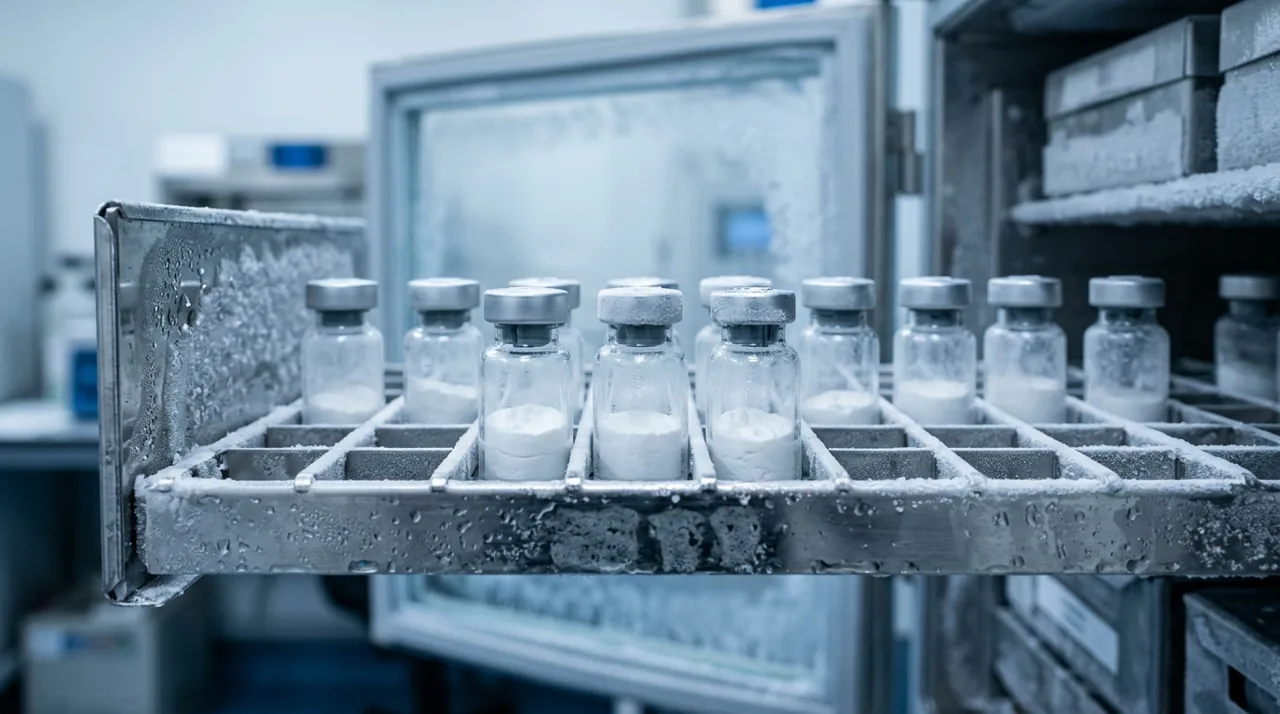
Research peptide storage conditions at a glance
The table below summarizes general storage conditions by physical state. The stability windows are deliberately broad because actual shelf life is compound-specific and should be confirmed against the documentation for each particular peptide. Treat these as starting points, not guarantees.
| Form / State | Typical storage condition | General stability window | Key risks |
|---|---|---|---|
| Lyophilized, long-term | Frozen, commonly -20°C or colder, desiccated and sealed | Generally many months to years, compound-dependent | Moisture ingress, repeated thawing of the stock vial |
| Lyophilized, short-term / in transit | Room temperature, brief ambient exposure acceptable | Generally days to weeks at ambient, varies by compound | Humidity, heat, prolonged warm exposure |
| Reconstituted, refrigerated | 2-8°C, protected from light | Often days to a few weeks, compound-dependent | Solution-state hydrolysis, oxidation, microbial growth |
| Reconstituted, frozen aliquots | Frozen in single-use portions | Generally longer than refrigerated, compound-dependent | Freeze-thaw damage if aliquots are re-frozen |
Storing lyophilized peptides
Lyophilized, or freeze-dried, peptide is the most stable form a research peptide takes, which is why suppliers ship it as a solid rather than a solution. Removing water removes the medium in which most degradation reactions proceed. Stored frozen, commonly at -20°C or colder, in a sealed and desiccated container, many lyophilized peptides remain usable for extended periods. The exact window depends on sequence and is best read from the compound’s own documentation rather than assumed.
Moisture is the primary enemy of a lyophilized powder. The material is hygroscopic, meaning it pulls water vapor directly out of the air. The most common way water gets in is condensation on a cold vial. When a vial straight from the freezer is opened, ambient humidity condenses on the cold glass and the powder, introducing the very water that freeze-drying removed. Always bring a vial to room temperature before breaking the seal, with the cap still closed, so that no surface in the vial sits below the dew point when it is opened. After taking what is needed, reseal promptly and return the stock to the freezer. Keeping a desiccant in the storage container and minimizing the time the vial spends open both reduce cumulative moisture exposure. Because heat accelerates degradation across every pathway, the freezer is doing more than slowing one reaction. Temperature is the master variable in storing lyophilized peptides.
Storing reconstituted peptides
Once a peptide is reconstituted, dissolved in a suitable diluent such as bacteriostatic water, its stability drops substantially. In solution the molecule is mobile, hydrated, and exposed to oxygen, and degradation pathways that are nearly frozen out in the solid state become active. Reconstituted material is generally refrigerated at 2-8°C and used within a comparatively short window, often a matter of weeks, though this varies by compound and should be confirmed against the specific peptide’s documentation.
For solution that will not be consumed quickly, aliquoting before freezing is the single most effective preservation step. Repeated freeze-thaw cycles degrade peptides through mechanical and chemical stress on the molecule, and each cycle compounds the damage. Dividing reconstituted material into single-use portions means each aliquot is thawed exactly once, so the remainder of the batch never sees a second cycle. Never re-freeze a thawed aliquot. Label every aliquot with the compound, concentration, and date at the moment it is made, because an unlabeled tube in a freezer is functionally lost.
The handling rules that actually matter
- Temperature: Keep lyophilized stock frozen and reconstituted material cold. Heat accelerates degradation across every pathway, so warm storage shortens usable life faster than any other single factor.
- Moisture: Bring vials to room temperature before opening, reseal quickly, and store with desiccant. Condensation on cold glass is the most common source of avoidable moisture.
- Light: Some peptides are photosensitive. Amber vials or storage in the dark protect light-sensitive sequences from photodegradation.
- Freeze-thaw: Aliquot before freezing so each portion is thawed only once. Do not re-freeze thawed solution.
- Labeling and dating: Record compound, concentration, and date on every vial and aliquot. Track the reconstitution date so the solution window is never guessed.
- Defer to the documentation: Sequence governs stability. Peptides containing Met, Cys, Trp, Asn, Gln, or an N-terminal Gln are more prone to oxidation or deamidation, so general windows do not apply uniformly. Confirm conditions against the certificate of analysis for the specific compound.
Signs a research peptide may have degraded
Visual inspection is a useful first check, though it is not a substitute for analytical confirmation. In a reconstituted solution, cloudiness, visible particulate, or a precipitate that will not redissolve can indicate aggregation or contamination, and a shift in color is another warning sign. A lyophilized powder that has clumped, gone tacky, or changed appearance has very likely taken on moisture. Incomplete dissolution on reconstitution, where material that should go fully into solution refuses to, is a further flag. None of these observations is definitive, because degradation can occur with no visible change at all, and a clear solution is not proof of an intact peptide. The only reliable measure of identity and purity is analytical testing such as HPLC and mass spectrometry, which is why batch-level data carries more weight than appearance.
Storage in transit
The robustness of lyophilized peptide is what makes shipping practical. As a dry solid, the material tolerates short ambient excursions that would degrade a solution, which is why research peptides travel as powders rather than pre-dissolved. A brief period at room temperature or moderate warmth during transit is generally well within the tolerance of a properly lyophilized and sealed peptide, with the caveat that prolonged heat exposure is still best avoided and that tolerance varies by compound. The relevant trade-offs between moisture and heat during shipping are covered in more depth in this cold-chain shipping guide. On arrival, the priority is to move the vial into appropriate long-term storage, applying the room-temperature-before-opening rule before any vial is unsealed.
After reconstitution
Reconstitution begins the shorter half of a research peptide’s storage life, so it is worth getting the mechanics right the first time. Accurate diluent volumes determine working concentration and keep the solution within a predictable handling window, and the arithmetic for this is set out in the reconstitution guide. From the moment a peptide is in solution, the conditions in the reconstituted-storage section apply: refrigerate, protect from light, aliquot, and date. Because stability is sequence-specific, the general windows here are no substitute for batch-level data. Defer to the documentation supplied with each compound, including the lab results for the specific batch on hand, which reflect that material’s actual composition rather than a generic assumption.
How to store research peptides: the short version
Keep lyophilized stock frozen, sealed, and dry, and bring each vial to room temperature before opening so condensation never reaches the powder. After reconstitution, refrigerate at 2-8°C, use the solution within a short window, and divide anything that will not be used promptly into single-use aliquots so no portion is frozen and thawed more than once. Protect photosensitive compounds from light, label and date everything, and treat the certificate of analysis as the authority on any given peptide’s stability. Heat and moisture cause most preventable losses, and both are simple to control.
Frequently asked questions
Do research peptides need to be refrigerated?
Lyophilized peptide is generally kept frozen rather than merely refrigerated for long-term storage, commonly at -20°C or colder, though it tolerates short ambient periods as a dry solid. Reconstituted material is the case where refrigeration at 2-8°C matters most, and it should be used within a relatively short window. Specific conditions vary by compound and should be confirmed against its documentation.
How long do reconstituted peptides last?
In solution, stability drops sharply compared with the lyophilized form, and refrigerated material is often usable for a matter of weeks. The exact window is compound-dependent because sequence determines how quickly hydrolysis and oxidation proceed. Frozen single-use aliquots generally extend usable life beyond refrigeration, provided they are never re-frozen.
Can lyophilized peptides survive shipping without ice?
As a dry solid, lyophilized peptide is reasonably robust to short ambient excursions, which is why it is shipped as a powder rather than a solution. Brief exposure to room temperature or moderate warmth in transit is generally well tolerated, though prolonged heat is still best avoided. Tolerance varies by compound, so on arrival the material should be moved promptly into appropriate storage.
Does freezing damage peptides?
Freezing itself is the standard long-term storage approach and is not the problem. The damage comes from repeated freeze-thaw cycles, each of which stresses the molecule. Aliquoting before freezing so that each portion thaws only once avoids this, which is why single-use aliquots are recommended for any solution intended for storage.
Conclusion
Understanding how to store research peptides comes down to controlling a small number of variables: temperature first, then moisture, light, and freeze-thaw exposure. Keep lyophilized material frozen and dry, handle reconstituted solution as the short-lived form it is, aliquot to avoid repeated thawing, and let each compound’s documentation override any general rule. Applied consistently, these habits preserve the integrity of a research material for as long as its chemistry permits. All peptides and guidance referenced here are intended strictly for laboratory research use only and are not for human or animal consumption.