Research-use-only (RUO) notice: This article is an educational reference monograph intended exclusively for in-vitro and laboratory research conducted by qualified professionals. Thymosin Alpha-1 supplied for research is not a drug, dietary supplement, cosmetic, or food, and nothing here constitutes medical advice, a therapeutic claim, a dosing recommendation, or an endorsement of human or veterinary use. References to clinical investigation in certain regions are reported as factual background only and do not describe the intended use of research-grade material. Investigators are responsible for compliance with all applicable institutional, biosafety, and jurisdictional requirements.
What Thymosin Alpha-1 Is
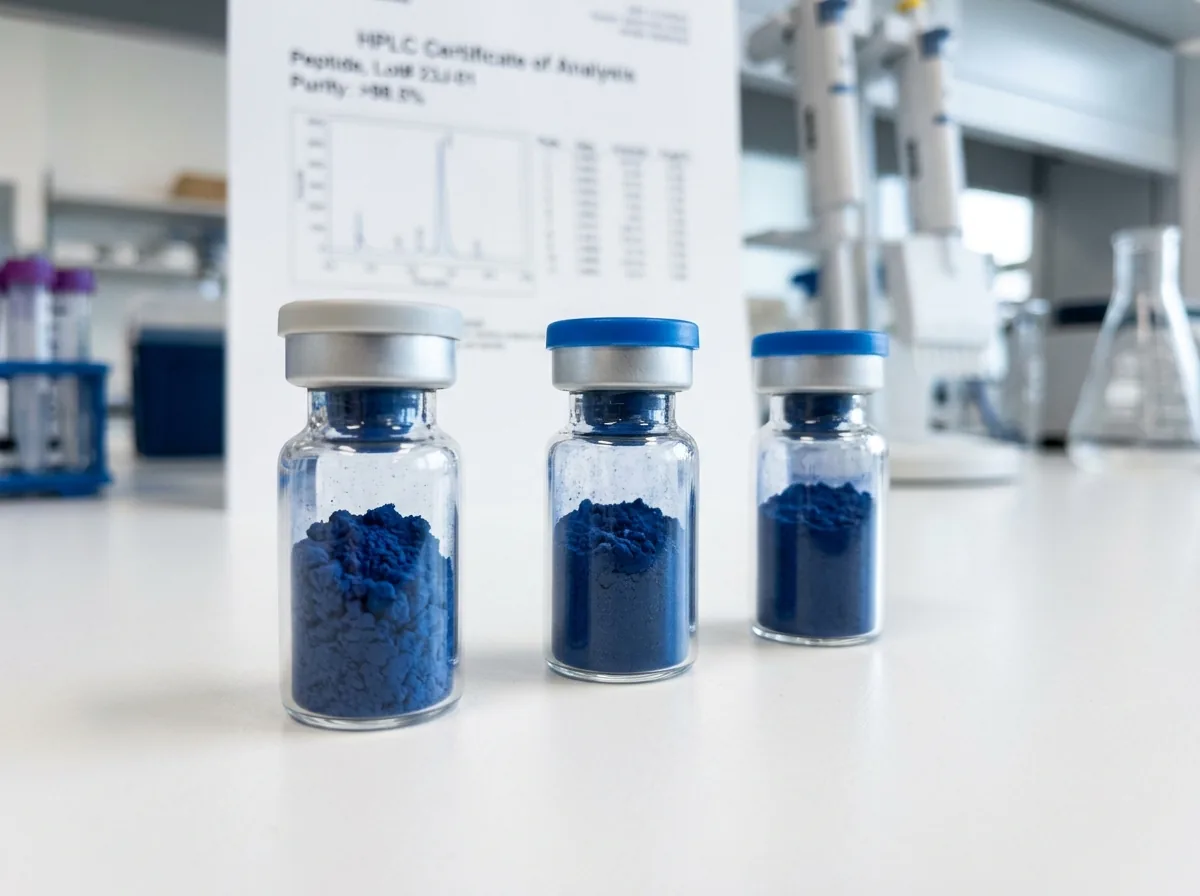
Thymosin Alpha-1 (Tα1) is a 28-amino-acid peptide that is N-terminally acetylated, giving it an acetylated serine at the amino terminus. It is acidic in character, carrying a high proportion of aspartate and glutamate residues, and has a molecular mass in the region of roughly 3.1 kDa. The peptide is not synthesised directly as a 28-residue product in vivo. Instead, it is a cleavage fragment derived from a larger precursor protein, prothymosin alpha, which is proteolytically processed to liberate the amino-terminal Tα1 sequence. The molecule was originally isolated from thymic tissue, the organ central to T-lymphocyte education and maturation, which is the historical reason it carries the “thymosin” name and the reason it has been studied principally in immunological contexts.
For research purposes, the material is typically produced by solid-phase peptide synthesis to yield a sequence structurally identical to the endogenous fragment, including the terminal acetylation. The acetyl group and the acidic residue profile are defining identity features: a preparation lacking the N-terminal acetylation, or showing a mass that does not correspond to the acetylated 28-mer, is not Tα1 and should be treated as a different or impure species. Because the peptide is short, highly charged, and lacks aromatic residues such as tryptophan, identity and quantitation work depends on appropriate analytical methods rather than simple UV-absorbance assumptions.
Mechanism and Pharmacology
Tα1 is studied as an immune modulator, not as an antimicrobial agent. This distinction is central, and it’s frequently misstated. The peptide isn’t described in the research literature as directly killing bacteria, viruses, or fungi. The documented research interest concerns how it appears to influence host immune signalling and the maturation state of immune cells, so that downstream immune responses are altered.
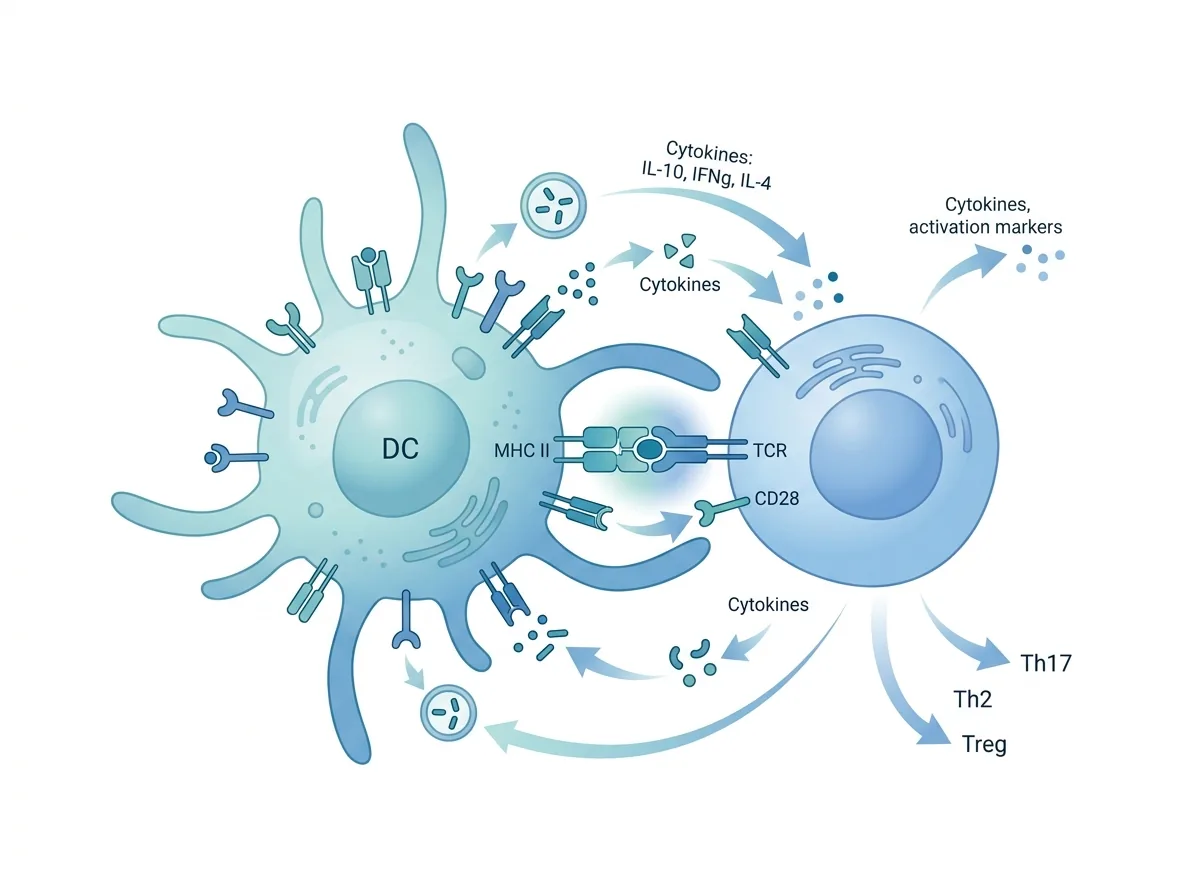
A recurring theme in published mechanistic work is the involvement of Toll-like receptor (TLR) signalling. Research has described Tα1 engaging or potentiating signalling associated with pattern-recognition receptors, with TLR2 and TLR9 frequently cited as relevant on dendritic cells and other innate immune cells. Engagement at this level is significant because TLRs sit at the interface of innate and adaptive immunity, and their downstream pathways feed into transcriptional programs that govern cytokine production and cell activation.
A second well-characterised research observation concerns dendritic-cell maturation and antigen presentation. In experimental systems, Tα1 has been associated with upregulation of co-stimulatory and antigen-presentation markers on dendritic cells, the cell type responsible for priming naive T cells. By affecting the maturation and activation state of these antigen-presenting cells, the peptide is studied for its potential to shape the quality and direction of subsequent T-cell responses, including the differentiation and polarisation of T-cell populations. The thymic origin of the molecule connects logically to this T-cell-oriented research focus.
A third theme is cytokine balance. Rather than acting as a simple, one-directional stimulant, Tα1 is studied as a context-dependent regulator that may shift the relative output of pro-inflammatory and regulatory cytokines depending on the experimental system and the activation state of the cells involved. This context dependence is part of why the literature characterises it as a “modulator”: in some model conditions the net effect of interest is enhanced effector signalling, while in others it concerns restoring or rebalancing immune signalling that has been suppressed or dysregulated in the model. Investigators should treat the specific direction and magnitude of any effect as a property of the model system under study, not as a fixed pharmacological constant.
What the Research Investigates
The research areas associated with Tα1 cluster around its immune-modulatory profile rather than around tissue repair or musculoskeletal endpoints. The principal categories described in the literature include the following.
- Immune-function models: studies of how the peptide influences innate and adaptive immune cell activity, maturation markers, and cytokine output in cell-culture and animal-model systems, including models of immune suppression or dysregulation.
- Infection research: work examining immune responsiveness in the context of viral and fungal challenge models, where the interest is the host immune response rather than any direct effect on the pathogen itself.
- Vaccine-adjuvant research: investigation of whether Tα1 can act as an immunological adjuvant by enhancing dendritic-cell maturation and antigen presentation, thereby influencing the magnitude or character of a vaccine-elicited response in experimental settings.
- Oncology research contexts: exploration of immune-modulatory effects in tumour-immunology model systems, where the research question concerns immune surveillance and response rather than direct cytotoxicity.
It’s factually accurate, and worth stating plainly, that Tα1 has a history beyond the laboratory bench. As the active component of the agent known generically as thymalfasin (associated with the brand name Zadaxin), the molecule has been investigated and, in a number of countries, used clinically — chronic hepatitis B is the indication most commonly cited, and it has been examined in additional settings across many jurisdictions. This clinical history is reported here strictly as background. It does not change the framing of research-grade material, which remains for laboratory research use only and is not offered, characterised, or fit for any clinical, diagnostic, or self-administration purpose. The existence of an approved drug product in some regions is not an endorsement of, or a substitute for, the regulatory and quality controls that apply to medicines.
Thymosin Alpha-1 vs Thymosin Beta-4 (TB-500)
One of the most common points of confusion in the peptide-research space is the assumption that Thymosin Alpha-1 and Thymosin Beta-4 are variants of one molecule. They aren’t. They share the historical “thymosin” naming convention because of early isolation from thymic preparations, but they are distinct peptides with different sequences, different sizes, different biology, and different research areas.
Thymosin Alpha-1 is the 28-residue, N-terminally acetylated, acidic fragment of prothymosin alpha described above. Its research centres on immune modulation: TLR signalling, dendritic- and T-cell maturation, and cytokine balance. Thymosin Beta-4 is a separate, larger peptide (commonly encountered in research as the fragment marketed under the research label TB-500); its research literature centres on actin sequestration and cytoskeletal dynamics, with investigational interest in cell migration, angiogenesis, and tissue-repair model systems rather than immune signalling. Same name family, different molecule, different research question. A researcher interested in immune-signalling endpoints would look at Tα1; a researcher interested in actin-binding and repair-model endpoints would look at the beta-4 family. For context on how the beta-4 family is positioned in repair-oriented research, see our BPC-157 and TB-500 stack research guide. Substituting one for the other based on the shared name is a methodological error that will invalidate any experiment.
What the Literature Does NOT Establish
Honest scope-setting is part of a responsible monograph. The following points describe limits, not endpoints to be claimed.
- No human dose is provided or implied here. Research-grade Tα1 is sold for laboratory use; this article contains no dosing, administration route, schedule, or protocol for human or veterinary use, and none should be inferred from any figure on a vial or certificate.
- Model-system and region-specific clinical use is not a general endorsement. The fact that thymalfasin is approved or investigated as a medicine in certain countries does not mean that research-grade material is equivalent to an approved drug, nor that any effect observed in a specific model generalises to other contexts, species, or outcomes.
- Mechanistic descriptions are research observations, not guaranteed effects. TLR engagement, dendritic-cell maturation, and cytokine shifts are reported in particular experimental systems; the direction and magnitude depend on the model, and outcomes are context-dependent rather than fixed.
- It is not an antimicrobial. Any framing that describes Tα1 as directly killing pathogens misrepresents the literature, which describes immune-host modulation.
- No safety, efficacy, or comparative-superiority claims are made. The peptide is not characterised here as safe or effective for any use outside controlled research.
Handling, Reconstitution and Stability
As with most synthetic research peptides, Tα1 is typically supplied as a lyophilised (freeze-dried) solid and should be handled accordingly. The lyophilised powder is generally the most stable form and is best kept cold, dry, and protected from light; long-term storage of the dry powder is usually at freezer temperatures, while short transit at refrigerated temperatures is generally tolerated. Always follow the storage conditions stated on the product certificate of analysis (COA), as these reflect the specific lot.
For reconstitution, the lyophilised peptide is dissolved in an appropriate sterile diluent for research handling. Bacteriostatic or sterile water is the common choice for laboratory work. The diluent should be added gently down the side of the vial and the solid allowed to dissolve without vigorous shaking, which can shear or denature peptide and generate foam that complicates accurate handling. Because Tα1 is highly charged and acidic, it generally reconstitutes readily in aqueous diluent; if material does not dissolve cleanly, that can itself be a flag for an identity or purity problem worth investigating before use.
Once in solution, peptides are markedly less stable than the dry powder. Reconstituted Tα1 should be kept refrigerated, used within a short working window, and protected from repeated temperature cycling. Repeated freeze-thaw cycles of an aqueous solution are a frequent cause of degradation and should be avoided; where longer storage of solution is unavoidable, single-use aliquots reduce the number of freeze-thaw events any one fraction experiences. To convert a target concentration into a diluent volume without arithmetic error, use our peptide reconstitution calculator guide, which walks through the concentration-to-volume relationship step by step.
Verifying Purity and Identity
For a short, acidic, acetylated peptide, label trust is not a substitute for analytical verification. The two questions that matter are whether the vial contains the correct molecule (identity) and how much of the content is the intended peptide versus related impurities (purity). The standard tools are chromatographic and mass-based analysis: reversed-phase HPLC to assess purity as a percentage of total peptide-related material, and mass spectrometry to confirm that the measured mass matches the acetylated 28-mer rather than a deletion sequence, a non-acetylated variant, or an unrelated species.
Two practices materially raise confidence. First, treat independent, third-party testing as more meaningful than vendor self-reporting, because an independent laboratory has no incentive tied to the result. Second, insist on a per-lot certificate of analysis rather than a generic or representative document, since purity and identity are properties of the specific batch in hand, not of the product name. You can review independent testing documentation on our lab results page, and our Janoshik match-batch page explains how to confirm that a published report corresponds to the exact lot you received rather than a different batch with a similar profile. If you are new to interpreting these documents, our how to read a peptide COA walkthrough explains what each section of an HPLC and mass-spec report actually tells you, including how to read the purity percentage and the mass confirmation.
Frequently Asked Questions
Is Thymosin Alpha-1 the same as TB-500?
No. They are different molecules that share the historical “thymosin” naming convention. Thymosin Alpha-1 is a 28-amino-acid acetylated fragment of prothymosin alpha studied for immune modulation. TB-500 belongs to the Thymosin Beta-4 family, a separate and larger peptide studied for actin binding and tissue-repair-model endpoints. Different sequence, different size, different research area. They aren’t interchangeable.
Is Tα1 an antibiotic or antiviral that kills pathogens directly?
No. The research literature characterises it as an immune modulator. The studied interest concerns how it influences host immune signalling (TLR pathways, dendritic- and T-cell maturation, and cytokine balance) rather than any direct microbicidal action on a pathogen.
Why does the literature mention clinical use if this is research-only?
Because both things are true at once. The molecule, as thymalfasin (Zadaxin), has been investigated and used clinically in a number of countries, which is reported here as factual background. The research-grade material discussed in this monograph is nevertheless for laboratory research use only, is not an approved drug, and carries no human-use framing. Regional clinical approval of a medicine is not an endorsement of research-grade material.
How should reconstituted material be stored?
Keep the dry, lyophilised powder cold, dark, and dry per the COA. After reconstitution in a sterile aqueous diluent, refrigerate, use within a short working window, avoid repeated freeze-thaw cycling, and consider single-use aliquots to limit degradation. Confirm specifics against the lot certificate.
How do I confirm the vial actually contains Tα1?
Rely on independent, third-party analysis tied to your specific lot: reversed-phase HPLC for purity and mass spectrometry to confirm the mass of the acetylated 28-mer. A per-lot COA matched to your batch is the verification standard; a generic document or a vendor claim alone is not.
Summary
Thymosin Alpha-1 is a 28-amino-acid, N-terminally acetylated, acidic peptide cleaved from prothymosin alpha and historically isolated from thymic tissue. In research it is studied as an immune modulator: the literature describes engagement with TLR-associated signalling, promotion of dendritic-cell maturation and antigen presentation, influence over T-cell responses, and context-dependent shifts in cytokine balance, not direct antimicrobial activity. Research areas span immune-function models, infection and vaccine-adjuvant studies, and oncology-immunology contexts. The molecule has a separate, factually noted history of clinical investigation and use as thymalfasin in some regions. It is distinct from Thymosin Beta-4 (TB-500), which is a different molecule with a different sequence and a tissue-repair research focus. For any research application, the responsible foundation is the same: maintain strict RUO framing, verify identity and purity through independent HPLC and mass-spec analysis against a per-lot certificate, and handle, reconstitute, and store the material to preserve its integrity.