Research-use-only (RUO) notice: This article is an educational reference intended for laboratory and research audiences. The material discusses GHK-Cu as a research compound in the context of in vitro, cell-culture, and animal-model literature. It is not medical advice, makes no efficacy or safety claims, and provides no human dosing guidance. GHK-Cu sold for research is not a drug, supplement, or cosmetic and is not intended for human or veterinary administration.
What GHK-Cu Is
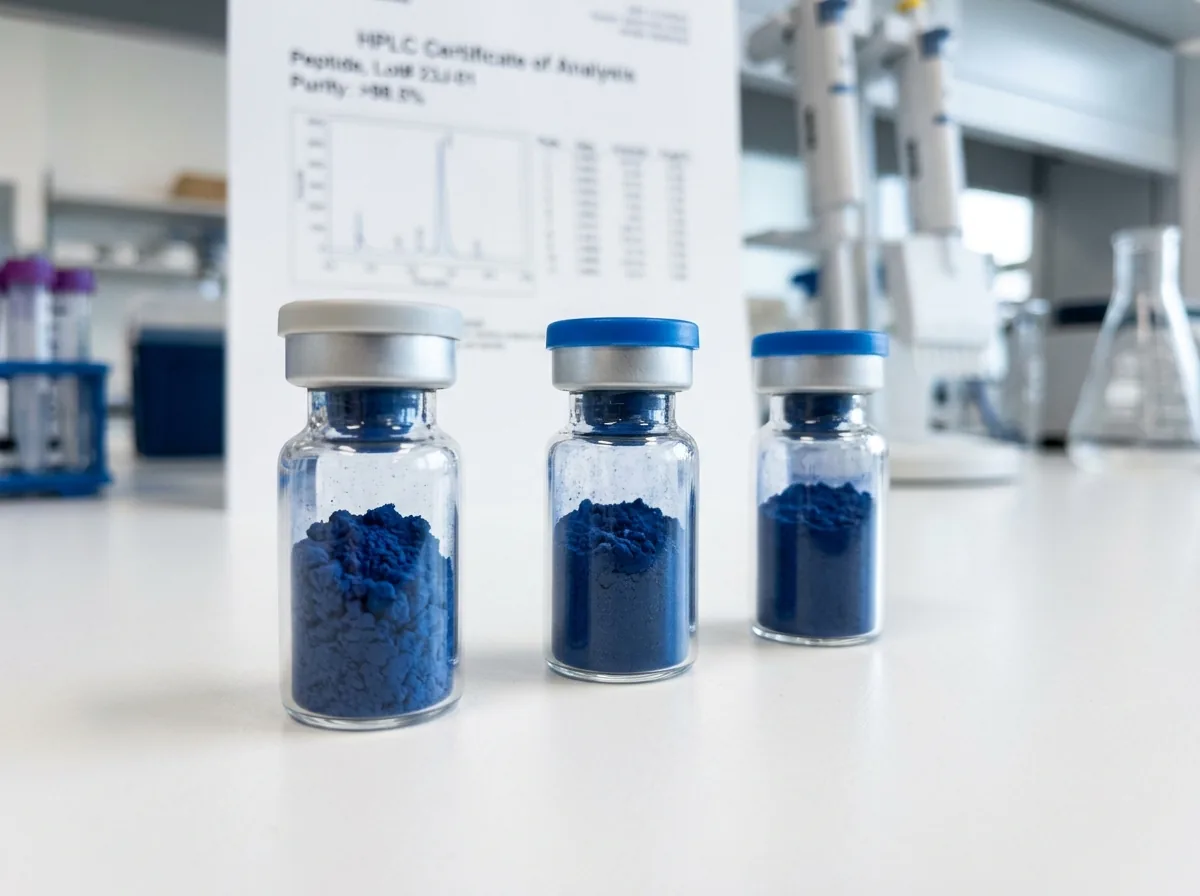
GHK-Cu is the copper(II) complex of GHK, a tripeptide with the sequence glycyl-L-histidyl-L-lysine (Gly-His-Lys). It’s a small, naturally occurring molecule. It was first isolated from human plasma in the early 1970s, where it was identified as a fraction associated with serum albumin. GHK is not a synthetic novelty. It’s an endogenous peptide present in human plasma, saliva, and urine. A frequently cited observation in the literature is that plasma GHK concentration is higher in younger individuals and declines with age, which is part of why the peptide became a subject of interest in tissue-repair and aging-related research.
The free tripeptide and its copper complex are studied as distinct entities, but the chemistry strongly favors the metal-bound form. GHK binds copper(II) with high affinity, and under physiological conditions the peptide readily sequesters available copper ions. For this reason, the research-relevant species in most biological contexts is GHK-Cu, the copper-loaded complex, rather than the bare peptide. The bound copper is also responsible for the compound’s characteristic deep blue color, a visual signature of an intact Cu(II)-peptide chelate. Lyophilised material and reconstituted solutions of GHK-Cu typically present as blue, whereas copper-free GHK is colorless.
Structurally, the copper(II) ion is held in a coordination geometry built from several donor atoms supplied by the peptide. The literature describes copper binding through the N-terminal glycine alpha-amino nitrogen, the deprotonated peptide (amide) nitrogen along the backbone, and the imidazole nitrogen of the histidine side chain. Carboxylate oxygen from neighboring complexes and the lysine residue contribute to the broader coordination environment, with lysine’s side chain interacting more prominently at alkaline pH while remaining important for cellular interactions at physiological pH. The net result is a compact, square-planar-type chelate that stabilizes copper in a form the peptide can carry and present to cells.
Mechanism and Pharmacology
Two complementary mechanistic threads run through the GHK-Cu literature: its role as a copper carrier, and its reported role as a modulator of gene expression. These aren’t separate stories so much as two faces of the same molecule.
As a copper carrier, GHK functions as a physiological chelator that can acquire, hold, and exchange copper(II). Copper is a required cofactor for several enzymes relevant to connective-tissue biology, including lysyl oxidase, which participates in the cross-linking of collagen and elastin, and superoxide dismutase, a copper-dependent antioxidant enzyme. By delivering copper in a controlled, peptide-bound form, GHK-Cu is studied as a vehicle that influences the local availability of a catalytically important metal rather than flooding a system with free, potentially pro-oxidant copper ions. This carrier behavior is a central reason the copper-bound form matters. Many of the activities attributed to GHK in cell models are weak or absent without the metal, because the biological readouts depend on copper-requiring processes.
The second thread is transcriptional. Gene-expression profiling in cultured cells has reported that exposure to GHK-Cu is associated with changes in the expression of a large number of genes, spanning categories such as extracellular-matrix (ECM) remodelling, collagen and glycosaminoglycan synthesis, antioxidant defense, and inflammatory signalling. This reported modulation is broad. It affects genes that are both up- and down-regulated across many functional groups. That’s one reason GHK-Cu is described in research contexts as a broadly acting signalling molecule rather than a single-pathway agonist. Read these findings as descriptions of model-system behavior. They characterize what changes in gene expression have been observed under specific laboratory conditions, not clinical outcomes in humans.
Because GHK-Cu is not a classical receptor ligand with one well-defined binding pocket, its pharmacology is better framed in terms of copper delivery plus pleiotropic transcriptional influence than in terms of a single dose-response curve at one receptor. This distinction matters for anyone designing experiments. The appropriate controls often include copper-free GHK, copper salts alone, and vehicle, precisely because the carrier and gene-modulation effects can be difficult to disentangle.
What the Research Investigates

The research literature on GHK-Cu clusters into several overlapping areas, almost all of which are in vitro or animal-model in nature.
Skin, ECM, and fibroblast activity
The most heavily studied area is skin and connective-tissue biology. In dermal fibroblast cultures and skin-model systems, GHK-Cu has been investigated for its association with collagen production, elastin, and glycosaminoglycan synthesis, the structural macromolecules of the dermal extracellular matrix. Researchers also examine its relationship to the enzymes that build and remodel the matrix, including the metalloproteinase family that degrades matrix proteins and the tissue inhibitors that restrain them. The interest here is the balance between matrix deposition and matrix breakdown, a balance central to how connective tissue maintains and renews itself.
Wound-healing models
GHK-Cu appears extensively in wound-healing research, including cell-migration assays, angiogenesis-related readouts, and animal wound models. The reported observations involve processes such as fibroblast and keratinocyte behavior, support for new blood-vessel formation, and modulation of the inflammatory phase of repair. These models examine mechanism and tissue response under controlled conditions; they do not establish a clinical wound-healing indication.
Antioxidant and anti-inflammatory signalling
A recurring research theme is GHK-Cu’s relationship to oxidative-stress and inflammatory pathways. Through its copper, the complex intersects with copper-dependent antioxidant enzymes, and gene-expression studies report changes in antioxidant-response and inflammatory-signalling genes. Researchers study whether and how the peptide shifts the cellular oxidative and inflammatory state, again as a mechanistic question rather than a therapeutic claim.
Hair-follicle biology
Because the hair follicle is a metabolically active mini-organ embedded in connective tissue, GHK-Cu has been examined in follicle and dermal-papilla cell models for its relationship to proliferation and growth-factor signalling. This is an active but still preliminary research area.
Cosmetic science
Separately from biomedical research, GHK-Cu is a long-standing subject in cosmetic-science formulation literature, where copper peptides are studied for stability in topical bases, delivery, and compatibility with other ingredients. This formulation literature is relevant to understanding the compound’s handling chemistry but should not be conflated with controlled efficacy data.
GHK-Cu Compared With Related Compounds
It helps to situate GHK-Cu against other peptides that appear in repair- and longevity-oriented research, because they are mechanistically distinct despite being grouped together in popular discussion.
GHK-Cu is unusual in being a metal-peptide complex whose activity is tied to copper delivery and to broad transcriptional modulation. That sets it apart from peptides studied primarily for cytoprotective or angiogenic signalling without a required metal cofactor. For example, compounds frequently discussed in tissue-repair research are studied for their own discrete mechanisms and are sometimes examined together. Readers exploring that space may consult a dedicated BPC-157 and TB-500 research guide for how those two are characterized. Those peptides don’t depend on a bound metal and are not blue. GHK-Cu’s copper chemistry is intrinsic to both its mechanism and its physical appearance.
Within the broader category of aging-related research peptides, GHK-Cu is distinguished by the sheer breadth of gene-expression changes reported for it and by its dual identity as both a signalling molecule and a copper-transport vehicle. For a wider survey of how such compounds are framed in the research literature, a general longevity research peptides guide provides additional context. The practical takeaway for experimental design is that GHK-Cu’s controls and stability considerations differ from those of metal-free peptides, because copper coordination introduces variables (pH sensitivity, redox behavior, and color as a readout) that simpler peptides don’t have.
What the Literature Does NOT Establish
Honest interpretation of the GHK-Cu literature requires stating its limits clearly.
- Model-system results are not human efficacy. The large majority of mechanistic findings come from cell culture and animal models. Gene-expression changes observed in vitro do not demonstrate that the same outcomes occur, at the same magnitude, in intact human tissue.
- No established human dose. The research literature does not define a validated human dose, route, or regimen for GHK-Cu. Any numeric figure presented as a human protocol is outside what the controlled evidence supports, and none is provided here.
- Breadth of gene modulation is not proof of benefit. A compound that influences many genes is not automatically safe or beneficial; broad activity can equally raise questions about specificity and off-target effects that remain incompletely characterized.
- Copper handling is double-edged. Copper is essential but also potentially pro-oxidant when dysregulated. The conditions under which GHK-Cu’s copper is protective versus harmful are model-dependent and not fully resolved.
- Cosmetic and biomedical literatures are not interchangeable. Formulation studies in topical cosmetic science address stability and delivery, not clinical therapeutic endpoints, and should not be cited as efficacy evidence.
In short, GHK-Cu is a well-characterized molecule at the level of chemistry and a much-studied one at the level of cell-model mechanism, but the translation of those findings into validated human outcomes is not established by the literature.
Handling, Reconstitution, and Stability
Research-grade GHK-Cu is typically supplied as a lyophilised (freeze-dried) blue powder. As with other peptides, the dry, sealed material is the most stable form and is best stored cold, dark, and dry. It’s commonly refrigerated for working stock and frozen for long-term storage of unopened vials, with desiccation to limit moisture uptake.
Reconstitution for laboratory work is generally performed with bacteriostatic water (or, depending on the experimental requirement, sterile or laboratory-grade water), added slowly down the vial wall rather than injected directly onto the powder, and dissolved by gentle swirling rather than vigorous shaking. For calculating the volume of diluent needed to reach a target working concentration, a peptide reconstitution calculator guide is the appropriate reference; do not rely on guesswork when concentration accuracy matters to an experiment.
Copper-peptide chemistry adds a stability nuance not present with metal-free peptides. The intact blue color is a useful at-a-glance indicator that the Cu(II)-peptide complex is coordinated; pronounced color change, precipitation, or cloudiness can signal degradation or dissociation of the complex. Because copper participates in redox chemistry, GHK-Cu solutions can be sensitive to pH extremes, prolonged warmth, and light, so reconstituted material should be kept cold and shielded from light and used within a limited working window. As a general rule for peptides, repeated freeze-thaw cycling of reconstituted solution should be avoided; aliquoting before freezing reduces the number of thaw cycles any single portion experiences.
Verifying Purity and Identity
For any research compound, identity and purity should be confirmed rather than assumed. The standard analytical approach is reversed-phase HPLC to assess purity and mass spectrometry to confirm identity, ideally reported on a per-lot certificate of analysis (COA) so that the documentation matches the specific batch in hand.
Independent, third-party testing strengthens confidence beyond a vendor’s internal claim. Published lab results and COAs let a researcher inspect the actual analytical data for a product, and a Janoshik match-batch verification approach, where the lot you receive corresponds to an independently tested batch, addresses the common gap between a generic certificate and the vial actually shipped. Reading these documents critically is a skill in itself; a walkthrough of how to read a peptide COA explains what the purity percentage, identity confirmation, and test method entries mean and what to scrutinize. For a copper peptide specifically, identity confirmation is worth extra attention because the desired species is the coordinated complex, not merely the presence of the peptide sequence.
Frequently Asked Questions
Why is GHK-Cu blue?
The blue color comes from copper(II) coordinated by the peptide. The specific arrangement of nitrogen donor atoms around the Cu(II) center produces the characteristic blue of the intact complex. Colorless material would suggest the copper is absent or the complex has dissociated.
Is the copper-free GHK the same thing?
No. Free GHK and GHK-Cu are studied as related but distinct species. Most reported biological activity in the literature is associated with the copper-bound form, because copper is required for several of the downstream processes (such as copper-dependent enzyme activity) that the research examines. Under physiological conditions GHK also tends to acquire available copper, further favoring the complex.
What makes GHK-Cu different from other “repair” peptides?
Its identity as a metal-peptide complex. Activity is tied to copper delivery and to broad gene-expression modulation, rather than to signalling through a single metal-independent pathway. This also changes its practical handling, since copper coordination introduces pH sensitivity, redox behavior, and color as a stability indicator.
How should reconstituted GHK-Cu be stored?
Cold and shielded from light, used within a limited working window, with freeze-thaw cycling avoided by aliquoting before freezing. A loss of the blue color or the appearance of cloudiness or precipitate is a sign to discard the solution rather than use it.
Does the research support using GHK-Cu in humans?
The available evidence is predominantly in vitro and animal-model based and does not establish human efficacy, safety, or any dosing protocol. GHK-Cu offered for research is for laboratory use only and is not intended for human administration.
Summary
GHK-Cu is the copper(II) complex of the endogenous tripeptide glycyl-L-histidyl-L-lysine, a small molecule originally isolated from human plasma whose levels decline with age. Its chemistry centers on high-affinity copper coordination through glycine, backbone amide, and histidine imidazole nitrogen donors, which both enables its function as a copper carrier and produces its signature blue color. Mechanistically, the research literature frames GHK-Cu as a dual-natured molecule: a controlled copper-delivery vehicle that feeds copper-dependent enzymes, and a broad modulator of gene expression touching ECM remodelling, collagen and glycosaminoglycan synthesis, antioxidant defense, and inflammatory signalling. The bulk of investigation lies in skin and ECM biology, wound-healing models, antioxidant and anti-inflammatory pathways, hair-follicle biology, and cosmetic-science formulation, overwhelmingly in cell and animal systems. Those findings characterize mechanism, not human outcomes. The literature doesn’t establish human efficacy, safety, or dosing. For researchers, sound practice means treating GHK-Cu as a copper complex with specific stability needs, reconstituting and storing it accordingly, and confirming identity and purity through independent, per-lot analytical documentation before any experimental use.