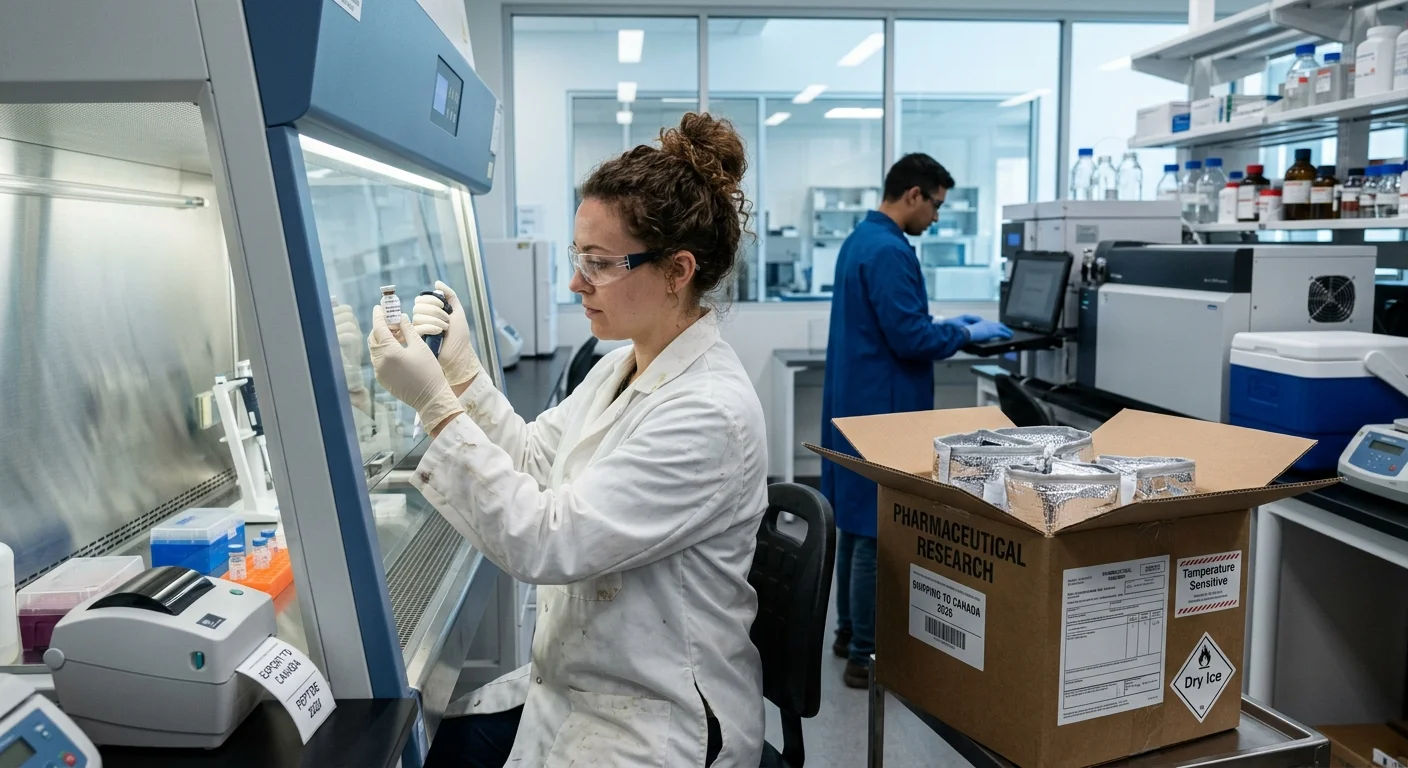
Roughly a third of research peptide orders that originate in the United States are bound for Canadian institutions or independent researchers. The cross-border layer is the single most operationally difficult part of the supply chain, and in 2026 it’s gotten harder, not easier. This is a practical walkthrough of how Canadian fulfillment actually works for research peptides, what the failure modes look like, and how to evaluate a supplier’s cross-border posture. Everything here is framed for research use only, and none of it is legal, customs, or medical advice.
The two failure modes
From the researcher’s perspective, two things can go wrong on a US-to-Canada shipment.
1. Customs detention
A package is held at the border for inspection or because the declared contents trigger a flag. Canadian Border Services Agency (CBSA) detentions usually resolve one of three ways: release after additional documentation, return-to-sender, or destruction. From the tracking history, the package shows “release pending” or stalls at “Customs Processing” for an extended period.
Baseline rate, across multiple supplier sources in 2026: somewhere around 10% of US-to-Canada research peptide shipments experience some form of customs intervention. The rate varies by destination province, declared value, packaging style, and carrier, but a single-digit-percentage failure rate is normal even for suppliers doing this competently. Shipments may be subject to inspection at any point, and that’s a structural reality of cross-border movement, not a sign that anything was done wrong.
2. Lost-in-carrier
Less common but operationally identical from the researcher’s perspective: the carrier loses the package after customs clearance, or marks it delivered when it wasn’t, or returns it without explanation. The supplier’s response policy to lost-in-carrier should be the same as to customs detention, reship without litigation.
Cold-chain and stability: what actually matters in transit
There’s a persistent myth that every peptide shipment needs to stay frozen door-to-door or the contents are ruined. For lyophilized (freeze-dried) research peptides, that’s mostly not how the chemistry works. The thing that degrades peptides is water. A properly lyophilized peptide sits at very low residual moisture, and in that dry state it’s far more tolerant of temperature swings than people assume.
General guidance from peptide-stability literature is consistent on a few points. Lyophilized peptides are typically stable at room temperature for days to weeks and routinely survive multi-day transit without measurable change to HPLC purity. Brief exposure to elevated temperatures during a transit window is usually tolerated; it’s sustained heat well above ambient, over long periods, that drives degradation. So the real enemy in a shipping box isn’t a warm afternoon on a loading dock. It’s a breached vial seal that lets humidity in.
This reframes what cold-chain means for a powder. The moisture barrier, the stopper seal, the desiccant if present, and the integrity of the vial matter more than whether an ice pack is still cold on arrival. A vial that arrives at room temperature with an intact seal is generally fine. A vial that arrives cold but with a compromised stopper is the one to worry about.
Where genuine cold chain does matter is after reconstitution. Once you’ve added bacteriostatic water or another diluent, the peptide is in solution and the stability clock speeds up. General references put reconstituted peptides at roughly a month or so when refrigerated at 2-8°C, and only days at room temperature, with the exact window depending on sequence, concentration, and pH. Freeze-thaw cycling is its own hazard. Each cycle can chip away at activity, and a few cycles is enough to cause meaningful loss for many sequences. The common lab practice is to aliquot into single-use portions before freezing, then thaw only what’s needed. If your protocol involves storage math, the reconstitution calculator guide walks through concentration and volume so you’re not guessing.
For shipping decisions, the practical upshot is this. Lyophilized material is robust enough that suppliers can ship it dry without aggressive cold-chain packaging, and that’s actually an advantage at the border. Cold-chain markings and ice-pack coolers draw extra customs attention. Compounds that genuinely need cold chain have no way around it. Compounds that don’t are better off shipped dry, both for stability reasons and for friction reasons.
What good supplier policy looks like
The defining policy is the answer to a single question: “If this shipment doesn’t arrive, what happens?”
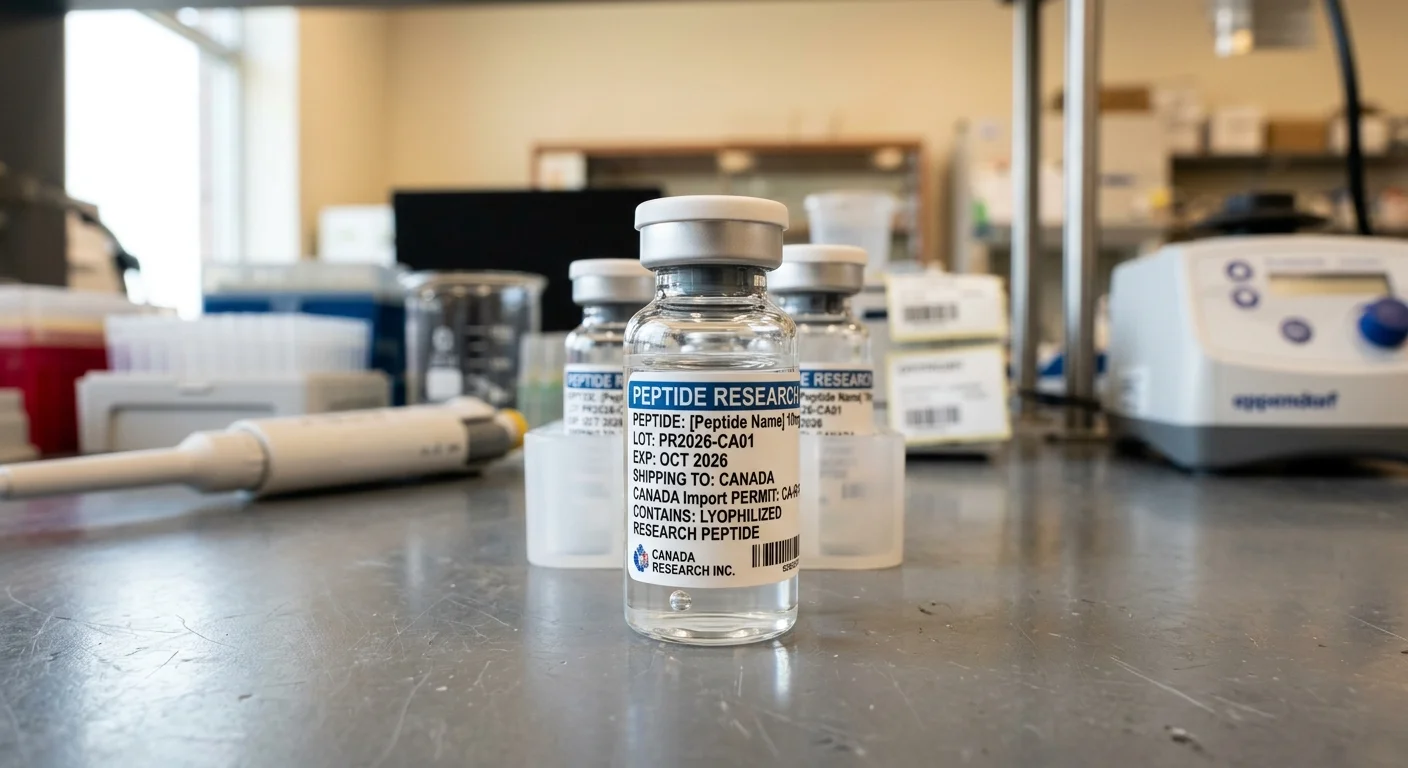
Good answer: “We reship at no cost. Send us your address; we’ll route the replacement through a different forwarder.” For each Canadian shipment, the batch lot number on the vial label can be cross-checked against the published Janoshik HPLC certificate of analysis, verify before reconstitution. That cross-check is the whole point of independent testing, and the match-batch guide shows how to line up the lot on your vial against the right COA. You can also browse the published certificates directly on the lab results page.
Bad answer: “Send us evidence the package was intercepted. We’ll review.”
The reason the first answer is right and the second is wrong: it’s structurally impossible for a customer to “prove” customs interception in a way a supplier can verify independently. CBSA doesn’t send proactive notifications to the recipient in many cases, the tracking just stops updating. Asking the customer to produce evidence is in practice asking them to do nothing and accept the loss. A supplier that builds reships into the operating cost of the business is one that has done the math: 10% intercept rate at ~$30 cost-per-reship is a 3% effective premium on Canadian orders, which is absorbable. A supplier asking customers to fight customs is offloading that cost back to the buyer.
Bastion Peptides ships from US fulfillment with a stated “free reship if customs seizes” policy. The replacement uses different routing, typically a different forwarder, sometimes a different carrier path, to avoid hitting the same flag pattern that triggered the first interception. The full terms live on the customs reship policy page, and the broader shipping policy covers timelines and carrier handling.
The packaging variables that actually affect intercept rate
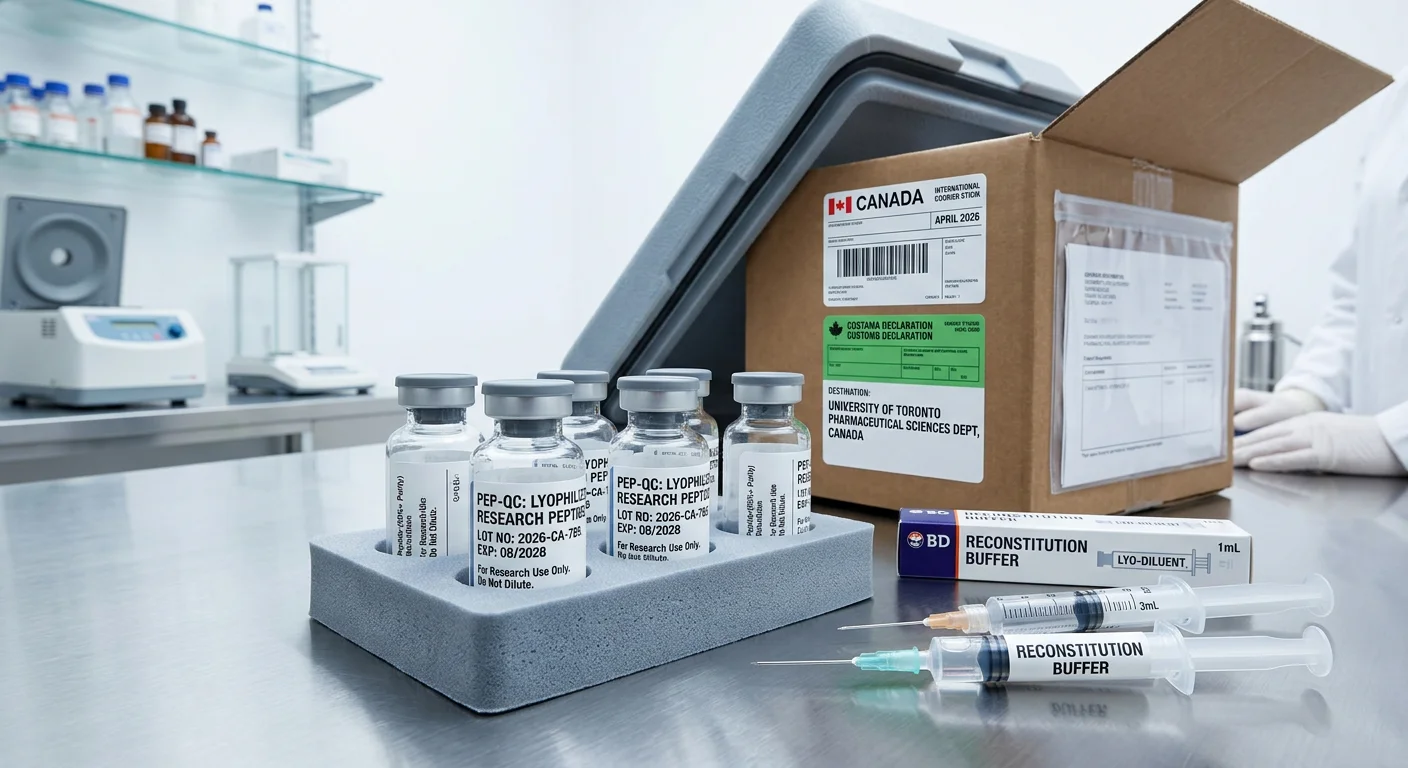
Within the constraints of safely shipping lyophilized peptides, several packaging choices affect customs friction:
- Declared value. A shipment declared at $400 receives more scrutiny than one declared at $30. Suppliers that declare values for research-use-only material at reasonable supply-cost levels generally see fewer flags than suppliers that declare them at retail.
- Package size and weight. A small bubble mailer routes through customs differently than a flat-rate box. Smaller is generally less flagged.
- HS code on the customs declaration. The Harmonized System code determines whether the shipment routes to general inspection or to pharmaceutical inspection. Suppliers experienced with cross-border use codes that route to general inspection, research chemicals or similar, rather than to drug review.
- Carrier. USPS-to-Canada Post hands off through a specific customs queue; FedEx and UPS handle their own customs brokerage with different inspection profiles. Different carriers have different effective intercept rates by category.
- Cold-chain markings. “Refrigerate on arrival” stickers and ice-pack cooler shipping draw additional attention. For compounds that genuinely need cold chain (reconstituted peptides, some lyophilized compounds), there’s no avoiding it; for compounds that don’t, eliminating the marking reduces flags.
Most of these are decisions the supplier makes for you. The researcher’s job is to choose a supplier that has clearly thought through these variables, not to micromanage individual shipments. None of this is about evading inspection. It’s about correct, honest classification of research-use-only material so it routes through the right queue the first time.
Packaging integrity: what protects the vial
Customs routing is one half of packaging. The other half is whether the powder survives the trip physically intact. Lyophilized peptide is a tiny amount of fragile cake or fine powder sitting at the bottom of a glass vial, and the things that wreck it in transit are mechanical, not bureaucratic.
Good shipping packaging for dry peptides does a few quiet jobs. It cushions the glass so vials don’t crack or chip during sortation. It keeps vials from rattling against each other, which can dislodge stoppers. And it protects the stopper seal, because the seal is the moisture barrier and the moisture barrier is the whole game for a lyophilized compound. Loose powder that has migrated up the vial wall, or a stopper that’s been pushed slightly out of seat, are the visible signs that the box took a beating. A small, snug mailer with proper internal cushioning tends to protect the contents better than a half-empty box where vials slide around, and it happens to draw less customs attention too.
What to check the moment your shipment arrives
When a Canadian shipment lands, a two-minute inspection on arrival saves a lot of downstream confusion. Here’s a reasonable checklist before anything goes into storage or gets reconstituted:
- Outer packaging. Note any crush damage, punctures, or signs the box was opened. If there’s obvious tampering or it looks like it was inspected, photograph it before opening.
- Vial integrity. Check each vial for cracks, chips around the neck, and a properly seated stopper. The seal is what keeps moisture out, so a lifted or loose stopper is the thing to flag.
- The cake itself. Lyophilized peptide should look like a dry, intact pellet or fine powder. Powder smeared up the vial walls usually just means rough handling, not necessarily a problem, but it’s worth noting.
- Moisture. Any visible condensation, dampness, or a powder that looks gummy or partially dissolved is a red flag, because water is what degrades these compounds.
- Label and lot number. Confirm the compound, quantity, and batch lot match your order, then cross-check that lot against the published certificate of analysis before you reconstitute anything. Comparing a vendor’s own paperwork against independent third-party results is the safeguard here, and the difference between the two is covered in the vendor COA vs independent testing writeup.
- Tracking record. Keep the tracking details and delivery confirmation in case you need to open a reship request later. You can pull current status anytime from the order tracking page.
What to do when your shipment stalls
A practical sequence when tracking hasn’t updated in 7+ days for a US-to-Canada shipment:
- Wait 48 more hours. Customs queues are not real-time; “Customs Processing” can sit static for two weeks and then resolve. Don’t escalate prematurely.
- Check your CBSA notifications. If CBSA has formally requested information about the shipment, you’ll have a letter or email from them. If you have nothing from CBSA, the shipment is in the queue, not actively reviewed.
- Email support. Request a reship if 14+ days have elapsed without movement past Customs Processing. Most reputable suppliers will reship without further documentation.
- Do not contact CBSA directly about the shipment. This is generally counterproductive and can escalate a passive review to an active one. Let the carrier and supplier handle customs interface.
- Update your address if you’ve moved. Reship goes to the address you confirm, don’t assume it goes to the original address.
What changes by destination province
Customs intercept rates aren’t uniform across Canada. Anecdotally from 2025-2026 supplier data:
- Ontario destinations (Toronto / GTA, Ottawa), slightly above the national average, possibly because of port-of-entry volume.
- Western Canada (BC, Alberta, Saskatchewan), close to the national average, with Vancouver intercept rates marginally higher than Calgary or Edmonton.
- Quebec destinations (Montreal, Quebec City), close to the national average, but customs correspondence comes in French by default, which is operationally easier for francophone recipients.
- Atlantic Canada (Halifax, Moncton, St. John’s), generally below the national average for intercept rate but with longer delivery times.
- Northern destinations (Yukon, NWT, Nunavut), too low volume to characterize statistically.
For researchers in higher-intercept regions, the practical mitigation is to ensure your supplier’s reship policy is strong, not to switch suppliers. Geographic intercept variance is real but not large enough to change which supplier you use; a supplier with a clean reship policy absorbs the variance for you.
Payment from Canadian buyers
Payment from Canadian researchers used to be a separate friction, Canadian Visa or Mastercard charges to US-domiciled research suppliers historically failed at the issuer. Bastion now uses a specialised PayPal/card processor that handles cross-border research-compound transactions cleanly, which has largely resolved the payment-layer rejection problem.
Putting it together
The Canadian cross-border layer is not a problem with a clever solution, it’s a problem suppliers have to absorb. The right supplier:
- Publishes a clear reship policy and stands behind it without litigation
- Uses packaging and declaration choices that route shipments through general inspection rather than pharmaceutical review
- Has a payment processor configured for Canadian cards and PayPal so buyers don’t get rejected at the payment layer
- Communicates clearly when shipments stall, sets expectations, and doesn’t disappear
Bastion Peptides is built around exactly this set: free reship if customs seizes, PayPal and card checkout, US fulfillment with packaging that’s been iterated for cross-border. The catalog is open for Canadian researchers without payment-side friction or surprise denials. You can browse available research compounds or place an order through the shop.
Frequently asked questions
Do research peptides need to be shipped frozen to Canada?
Generally no, for lyophilized material. Freeze-dried peptides are dry and tolerate normal transit temperatures because degradation needs water, not warmth. Brief exposure to ambient or even somewhat warm conditions during a multi-day shipping window is typically fine for the powder. Cold chain matters most after reconstitution, when the peptide is in solution and should be refrigerated or aliquoted and frozen.
My package has been stuck at “Customs Processing” for ten days. Is it lost?
Not necessarily. Customs queues aren’t real-time, and a shipment can sit static for a couple of weeks before clearing. The general guidance is to wait it out past the two-week mark before requesting a reship, and to avoid contacting CBSA directly, which can turn a passive review into an active one.
What happens if CBSA seizes or destroys my shipment?
With a supplier that runs a reship policy, you confirm your address and a replacement goes out, usually through different routing to avoid the same flag. You shouldn’t be asked to prove the interception, since recipients often get no formal notice and the tracking simply stops. See the customs reship policy for specifics.
How do I know the peptide I received is what the label says?
Check the batch lot number on the vial against the published independent certificate of analysis before reconstituting. The match-batch process shows how to line up your lot with the correct COA, and the lab results library holds the published certificates.
Is it legal to receive research peptides in Canada?
This guide doesn’t offer legal advice, and regulatory status depends on the specific compound and your jurisdiction. Research-use-only material is intended for laboratory and in-vitro work, and researchers are responsible for understanding the rules that apply to them. Shipments may be subject to customs inspection regardless of supplier.
For research use only. Bastion Peptides supplies compounds intended for laboratory and in-vitro research. Not for human or veterinary consumption.