Peptide reconstitution math is not difficult, but it’s the operational step where careless errors most often happen. Researchers who buy lyophilized peptides have to convert two inputs, mg of peptide in the vial, mL of bacteriostatic water added, into a usable concentration and a syringe-volume that delivers the intended amount. This is the math, explained from first principles, with worked examples for three common vial sizes. The interactive peptide calculator below does the arithmetic; this article explains what’s happening behind it so you can sanity-check every result.
This is a math walkthrough, not a dosing guide. Bastion Peptides supplies research-use-only compounds. The math here applies to laboratory reconstitution; researchers are responsible for the inputs and interpretation.
Peptide reconstitution calculator
Enter the vial mass (mg) and the bacteriostatic water volume (mL); the tool returns the concentration in mg/mL and what each common insulin-syringe line (30u, 50u, 100u) delivers. It is a math tool, it does not know which compound you have or what a protocol calls for, so the researcher remains responsible for the inputs and their interpretation.
Bastion provides this calculator as a math tool — you are responsible
for the inputs and interpretation.
mg / mL
(2500 mcg / mL)
| Syringe | Volume drawn | Peptide delivered |
|---|---|---|
| 30u (0.30 mL) | 0.30 mL | 0.75 mg |
| 50u (0.50 mL) | 0.50 mL | 1.25 mg |
| 100u (1.00 mL) | 1.00 mL | 2.50 mg |
“u” markings on insulin syringes = 1/100 mL. A “30u” line means 0.30 mL drawn.
The math: peptide_mg ÷ water_mL × volume_drawn_mL = mg delivered.
The single equation
Every reconstitution math problem reduces to one equation:
peptide_mg ÷ water_mL × volume_drawn_mL = mg delivered per draw
Three numbers in, one number out. The “concentration” intermediate (mg/mL) is just the first division done, peptide_mg ÷ water_mL.
The insulin syringe convention
The complication is that research-use syringes are marked in “units” rather than mL. A standard insulin syringe is a 100u syringe, 100 units = 1.0 mL. The math:
- 1u line = 0.01 mL
- 30u line = 0.30 mL
- 50u line = 0.50 mL
- 100u line = 1.00 mL (full syringe)
If you’re working with smaller syringes, 50u or 30u, the same line numbers apply but you can only draw up to the syringe’s max:
- A 50u syringe maxes out at 0.50 mL (the 50u line is the top)
- A 30u syringe maxes out at 0.30 mL (the 30u line is the top)
For a research protocol that needs exactly 0.20 mL drawn, you can use any of these, 20u line on any of them.
Worked example 1, 5mg BPC-157 vial, 2 mL water
Researcher has a BPC-157 5mg vial from Bastion and reconstitutes with 2.0 mL of bacteriostatic water. What concentration, and what does a 25u draw deliver?
- Step 1: concentration = peptide_mg ÷ water_mL = 5 ÷ 2 = 2.5 mg/mL
- Step 2: 25u line = 0.25 mL
- Step 3: delivered = 2.5 mg/mL × 0.25 mL = 0.625 mg per 25u draw
Convert to mcg if helpful: 0.625 mg = 625 mcg.
Worked example 2, 10mg vial, 1 mL water
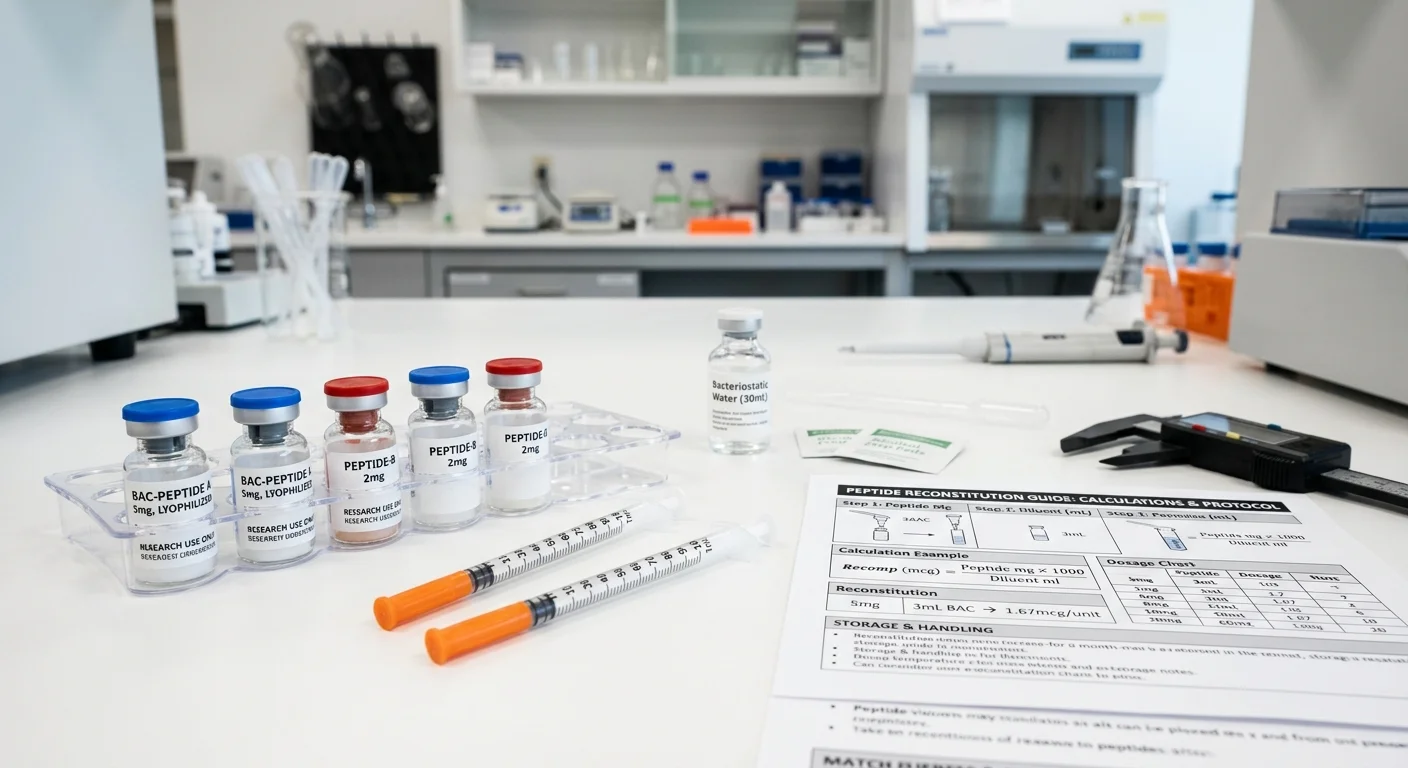
Same compound, different reconstitution. BPC-157 10mg vial, 1.0 mL water:
- concentration = 10 ÷ 1 = 10 mg/mL
- 25u line = 0.25 mL
- delivered = 10 × 0.25 = 2.5 mg per 25u draw
Same line on the same syringe delivers 4× the mass, because the concentration is 4× higher. Reconstituting with less water for the same vial mass concentrates the solution proportionally.
Worked example 3, 600mg Glutathione vial, 6 mL water
Glutathione 600mg reconstituted with 6 mL of bacteriostatic water:
- concentration = 600 ÷ 6 = 100 mg/mL
- 50u line = 0.50 mL
- delivered = 100 × 0.50 = 50 mg per 50u draw
Glutathione is a larger-mass compound than the synthetic peptides above, which is why a single vial weighs 600 mg rather than 5-10 mg. The math is identical; only the input numbers change.
How much bacteriostatic water to use
There’s no single right answer, the reconstitution volume is a researcher choice that affects:
- Concentration. Less water = higher concentration = smaller draw volume for the same mass delivered.
- Solution stability. Some peptides are more stable at lower concentrations; some are more stable at higher. Compound-specific.
- Vial life. The volume you reconstitute is the volume you have to use before the solution loses potency (typically 2-4 weeks refrigerated, depending on compound).
A practical default for most research peptides is to reconstitute so the concentration is 5 mg/mL or 10 mg/mL, neither extreme is generally needed, and round numbers reduce arithmetic errors. For a 5 mg vial that’s 0.5 mL or 1.0 mL of water; for a 10 mg vial that’s 1.0 mL or 2.0 mL.
What bacteriostatic water actually is
Bacteriostatic water is sterile water containing 0.9% benzyl alcohol as a bacteriostatic agent, it inhibits bacterial growth in the reconstituted solution, extending usable life from a few days (with plain sterile water) to a few weeks. This is the standard reconstitution solvent for research peptides.
It comes in 10 mL multi-dose vials with a rubber septum cap. Each draw withdraws a portion; the remaining solution stays viable as long as the cap isn’t compromised. Bastion’s bacteriostatic water is included in several stack bundles for this reason.
Storage after reconstitution
General research storage guidance (compound-specific guidance overrides):
- Lyophilized (powder, sealed vial): stable at room temperature for weeks, longer at refrigerator temperature, much longer frozen.
- Reconstituted (in bacteriostatic water): refrigerate at 2-8°C immediately. Usable life varies by compound; check the specific compound’s stability profile.
- Do not freeze reconstituted solution unless the protocol specifically calls for it, freeze-thaw cycles can degrade peptide structure.
The Bastion Lab Results page lists per-batch HPLC tests for current stock; reconstituted stability isn’t on the COA itself but the literature for each compound is generally clear.
Reconstituting to a target concentration
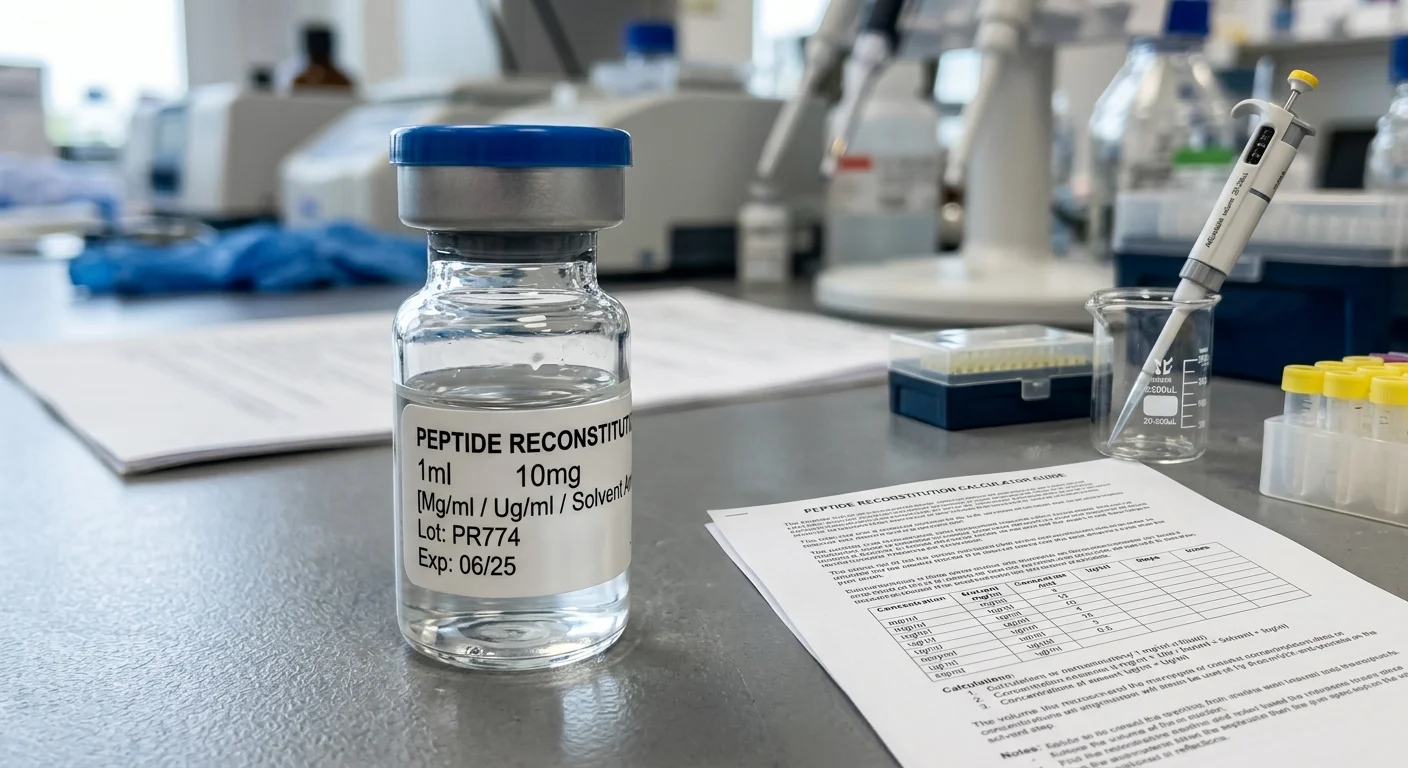
The worked examples above start from a chosen water volume and solve for concentration. Researchers often need the reverse, “I want a 5 mg/mL solution from a 10 mg vial; how much water?” Rearrange the same equation:
water_mL = peptide_mg ÷ target_mg_per_mL
For a 10 mg vial at a 5 mg/mL target: 10 ÷ 5 = 2.0 mL of bacteriostatic water. For a 5 mg vial at 2 mg/mL: 5 ÷ 2 = 2.5 mL. Choosing the concentration first and back-solving the water volume is usually the cleaner workflow, because it lets a lab standardize draw volumes across different compounds.
Quick-reference concentration table
Common vial-mass and water-volume combinations and the resulting concentration:
| Vial mass | Water added | Concentration | 0.25 mL (25u) draw delivers |
|---|---|---|---|
| 5 mg | 1.0 mL | 5 mg/mL | 1.25 mg |
| 5 mg | 2.0 mL | 2.5 mg/mL | 0.625 mg |
| 10 mg | 1.0 mL | 10 mg/mL | 2.5 mg |
| 10 mg | 2.0 mL | 5 mg/mL | 1.25 mg |
| 2 mg | 1.0 mL | 2 mg/mL | 0.5 mg |
| 2 mg | 2.0 mL | 1 mg/mL | 0.25 mg |
The same proportional relationship holds for any vial: halving the water doubles the concentration, and the draw delivers proportionally more mass.
Lyophilized peptides, proteins, and antibodies, the same math
The reconstitution arithmetic is identical whether the lyophilized powder is a short synthetic peptide (BPC-157, CJC-1295), a larger compound such as glutathione, or a lyophilized protein or antibody preparation: mass in the vial divided by solvent volume gives concentration. What changes between molecule classes is the appropriate solvent and handling, not the math. Larger proteins and monoclonal antibodies are frequently reconstituted in a defined buffer rather than bacteriostatic water and can be sensitive to mechanical stress, the standard practice is to add solvent slowly down the vial wall and swirl gently rather than shaking, which can denature sensitive structures. For the synthetic research peptides in Bastion’s catalog, bacteriostatic water is the standard solvent and gentle swirling is sufficient.
Common arithmetic errors
Three errors that cause most reconstitution math mistakes:
- Confusing mg and mcg. A draw delivering 0.625 mg is delivering 625 mcg. Worth being explicit about which unit you’re tracking in protocol notes.
- Mis-reading insulin syringe gradations. The lines are labeled in units (u), and the “1” line on a 100u syringe is 1u = 0.01 mL, not 1.0 mL. The single most common error in reconstitution math is confusing “1u” with “1 mL.”
- Forgetting that the vial contains the labeled mg. A 5 mg vial holds 5 mg of peptide regardless of how much water you add. The water doesn’t add peptide; it just dilutes what’s there. The total mass available from the vial is the labeled mass.
Reconstitution by compound, quick reference
The single equation above works for any vial; this table gives the community-cited bacteriostatic-water volumes for the most-reconstituted research compounds, with the resulting concentration. Draw volume for a given research aliquot follows the same mg ÷ (mg/mL) math shown in the worked examples, these figures only set the starting concentration.
| Compound | Typical vial | BAC water to add | Resulting concentration |
|---|---|---|---|
| BPC-157 | 5 mg | 2 mL | 2.5 mg/mL (2,500 mcg/mL) |
| TB-500 (Thymosin β4) | 5 mg | 1 mL | 5 mg/mL |
| BPC-157 + TB-500 blend (the “Wolverine” pairing) | 5 mg + 5 mg | 2 mL | 2.5 mg/mL of each |
| Tirzepatide | 10 mg | 1 mL | 10 mg/mL |
| Retatrutide | 10 mg | 1 mL | 10 mg/mL |
| Semaglutide | 5 mg | 1–2 mL | 5 mg/mL – 2.5 mg/mL |
| CJC-1295 / Ipamorelin | 2 mg / 5 mg | 2 mL | 1 mg/mL / 2.5 mg/mL |
| GHK-Cu | 50 mg | 5 mL | 10 mg/mL |
For combined or blended vials (such as the BPC-157 + TB-500 pairing), the same volume reconstitutes both peptides simultaneously, each reaches its own concentration independently. Adding water to a blend does not change the per-peptide math; you simply track two concentrations from one vial. Verified Bastion vials ship lyophilized with a batch-matched Janoshik COA; compounds still pending testing are listed as such on that page. Confirm identity and purity before reconstituting.
Embed this calculator (free)
Run a research forum, blog, or resource page? You are welcome to embed this reconstitution calculator on your own site at no cost, it is self-contained and mobile-friendly. Copy the snippet below; the only condition is that you keep the attribution link intact.
<iframe src="https://bastionpeptides.com/tools/reconstitution-calculator/" width="100%" height="640" style="border:0;max-width:720px" loading="lazy" title="Peptide Reconstitution Calculator"></iframe>
<p>Peptide reconstitution calculator by <a href="https://bastionpeptides.com/peptide-reconstitution-calculator-guide/">Bastion Peptides</a></p>
Preview:
Peptide reconstitution calculator by Bastion Peptides
Related research guides
Once a compound is reconstituted, the next questions are usually about the compound itself and the documentation behind it:
- CJC-1295 DAC vs No DAC research guide, half-life, mechanism, and form selection.
- Match-Batch verification, how per-lot Janoshik testing ties one COA to one production batch.
- Lab Results, the public archive of per-batch HPLC certificates for current stock.
For research use only. Bastion Peptides supplies compounds intended for laboratory and in-vitro research. Not for human or veterinary consumption.
Worked examples here use compounds such as BPC-157 and Semaglutide 5mg; the same reconstitution math applies to any lyophilized peptide. For research use only.