Improper reconstitution and storage are among the most common causes of degraded peptide performance in research settings — and among the most avoidable. This guide covers the complete handling protocol for lyophilized research peptides, from receiving your order through long-term aliquot storage.
Why Lyophilization Matters
Most research-grade peptides are shipped in lyophilized (freeze-dried) form. Lyophilization removes water from the peptide under vacuum at low temperature, leaving a dry powder that is significantly more stable than a liquid formulation. Under correct storage conditions, lyophilized peptides can maintain integrity for 12–24 months, sometimes longer for stable sequences.
The instability of peptides in solution — particularly oxidation-sensitive sequences and those containing methionine, cysteine, tryptophan, or glutamine residues — makes reconstitution timing important. Do not reconstitute more than your assay requires.
Before You Open the Vial
Equilibration to room temperature
Allow the vial to reach room temperature before opening. Peptide vials stored at -20°C will accumulate condensation on the inside of the vial if opened cold. Moisture entry before reconstitution can cause localized degradation. Let the sealed vial sit at room temperature for 20–30 minutes before proceeding.
Confirm the vial is intact
Inspect the rubber stopper and crimped cap before opening. Any sign of tampering, vacuum loss, or powder clumping against the stopper should be documented and the supplier contacted. Lyophilized peptide should appear as a light, cohesive powder or loosely packed cake — not a compressed solid or discolored material.
Reconstitution Protocol
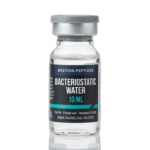
The reconstitution solvent affects peptide stability, solubility, and shelf life in solution. Bacteriostatic water (sterile water with 0.9% benzyl alcohol) is the standard choice for research peptides — the benzyl alcohol inhibits microbial growth and extends usable solution life.
Step-by-step reconstitution:
- Use a sterile insulin syringe or reconstitution syringe
- Draw up the required volume of bacteriostatic water
- Wipe the rubber stopper with an alcohol swab and allow to dry
- Insert the needle at an angle, directing the stream of water down the side of the vial wall, not directly onto the peptide powder
- Allow the water to flow down slowly — do not jet the liquid directly at the powder
- Remove the needle and swirl the vial gently in a circular motion
- Do not vortex — this can introduce air bubbles and mechanical shear stress that fragment some peptide structures
- Allow 5–10 minutes for complete dissolution; larger peptides may require longer
- Inspect for clarity — a clear, colorless solution is expected for most peptides; slight yellow tint is acceptable for some sequences
Solubility note: Some hydrophobic peptides require a co-solvent. If the peptide does not dissolve in bacteriostatic water alone, try adding a small volume (10–20%) of DMSO or acetic acid (0.1M), then diluting with water. Consult the compound-specific protocol on the product page for sequence-appropriate guidance.
Concentration Calculation
Determine your target concentration before drawing up solvent volume. The standard formula:
For example, to reconstitute a 5mg vial to 1mg/mL: add 5mL of bacteriostatic water. To reconstitute to 2mg/mL: add 2.5mL. Common research concentrations are 0.5–2mg/mL; higher concentrations may reduce solubility for some sequences.
Storage After Reconstitution
Short-term (up to 4 weeks)
Store at 4°C (refrigerator). Keep away from light. For oxidation-sensitive peptides, minimize headspace in the vial or overlay with nitrogen. Use within 4 weeks.
Long-term (months)
Aliquot into single-use volumes and store at -80°C. This eliminates repeated freeze-thaw cycles, which progressively degrade peptide integrity.
Freeze-thaw cycles: Each freeze-thaw cycle introduces mechanical stress that can break peptide bonds, particularly in longer sequences. For any peptide you expect to use over more than 2–3 sessions, aliquot before freezing into per-experiment volumes. A single-use aliquot schema — freeze once, thaw once, use — is the gold standard for maintaining peptide integrity across a research timeline.
Lyophilized Storage (Unopened)
If you are not using a compound immediately, leave it lyophilized. Store at -20°C in a dry environment. A desiccant in the storage container adds a secondary moisture barrier. Avoid repeated opening of the freezer if humidity is a concern in your environment.
Most research-grade lyophilized peptides retain specification-level purity for 12–24 months under these conditions. Longer-term stability varies by sequence — sequences containing methionine, cysteine, or free N-terminal glutamine are more susceptible to oxidation and pyroglutamate conversion respectively.
This article is for informational purposes for qualified researchers. All peptides sold by Bastion Peptides LLC are intended for in vitro research and laboratory use only. Not for human or animal consumption. Not approved by the FDA for therapeutic use.